


Transport to Southeast Europe requires a high degree of flexibility from transport company owners. Bulgaria, although an EU member, has a specific road toll system, BG Toll, which in 2026 places even greater emphasis on digitalization and ecology. Additionally, operating in a country outside the Eurozone (despite the lev’s fixed peg to the Euro) generates exchange rate risks that, on a large scale, can significantly reduce freight profitability.
How to effectively manage road tolls in Bulgaria for trucks and what to look for when refueling on the route to Sofia or Varna? Here are the key educational aspects.
System BG Toll 2026: How to Avoid Fines and Errors?
Unlike vignette systems for passenger cars, trucks over 3.5 tons in Bulgaria are charged based on actual kilometers driven. The system utilizes satellite technology (GNSS) and microwaves (DSRC).
What Determines the Toll Rate in Bulgaria?
In 2026, the fee calculation algorithm in the BG Toll system is based on three main pillars:
- Emission Class (EURO): The differences between Euro V and Euro VI are significant, and older units are burdened with progressive “environmental” rates.
- Number of Axles and GVW: The heavier the set, the higher the base fee per kilometer for motorways and national roads.
- Road Type: Bulgaria has a dense network of toll roads (not only motorways but also Class I and partially Class II roads).
Table 1: BG Toll Payment Methods - A Comparison for Professionals
| Method | Route Pass | Local Operator (OBU) | EETS System (e.g., Smart Pass) |
|---|---|---|---|
| Application | Occasional trips | Bulgaria only | International transport |
| Flexibility | Low (fixed route) | Medium | High (all of Europe) |
| Payment | Pre-paid | Often Pre-paid | Consolidated invoice (Post-paid) |
| Risk of Fine | High (deviating from route) | Medium | Minimal (automation) |
Table 2: Detailed Breakdown of Road Toll Rates in Bulgaria
| Vehicle Weight | Axles | A (Euro 6) | B | C | D | E | F |
|---|---|---|---|---|---|---|---|
| ≤ 3.5 t, Van | 0.06 BGN | 0.07 BGN | 0.08 BGN | 0.08 BGN | 0.09 BGN | 0.09 BGN | |
| 3.5-7.49 t | 0.06 BGN | 0.07 BGN | 0.08 BGN | 0.09 BGN | 0.10 BGN | 0.11 BGN | |
| 7.5-11.99 t | 2-3 | 0.08 BGN | 0.09 BGN | 0.10 BGN | 0.11 BGN | 0.12 BGN | 0.13 BGN |
| 12-18 t | 2-3 | 0.12 BGN | 0.13 BGN | 0.14 BGN | 0.15 BGN | 0.16 BGN | 0.17 BGN |
| > 18 t | ≤ 3 | 0.15 BGN | 0.16 BGN | 0.17 BGN | 0.18 BGN | 0.19 BGN | 0.20 BGN |
| 4 | 0.17 BGN | 0.18 BGN | 0.19 BGN | 0.20 BGN | 0.21 BGN | 0.22 BGN | |
| ≥ 5 | 0.18 BGN | 0.19 BGN | 0.20 BGN | 0.21 BGN | 0.22 BGN | 0.23 BGN |
Discover Our Route Calculator
You already know the rates and what to watch out for regarding currency conversions, but manually calculating costs for a route spanning thousands of kilometers is a direct path to errors. That is why we provide you with a tool that does it for you.
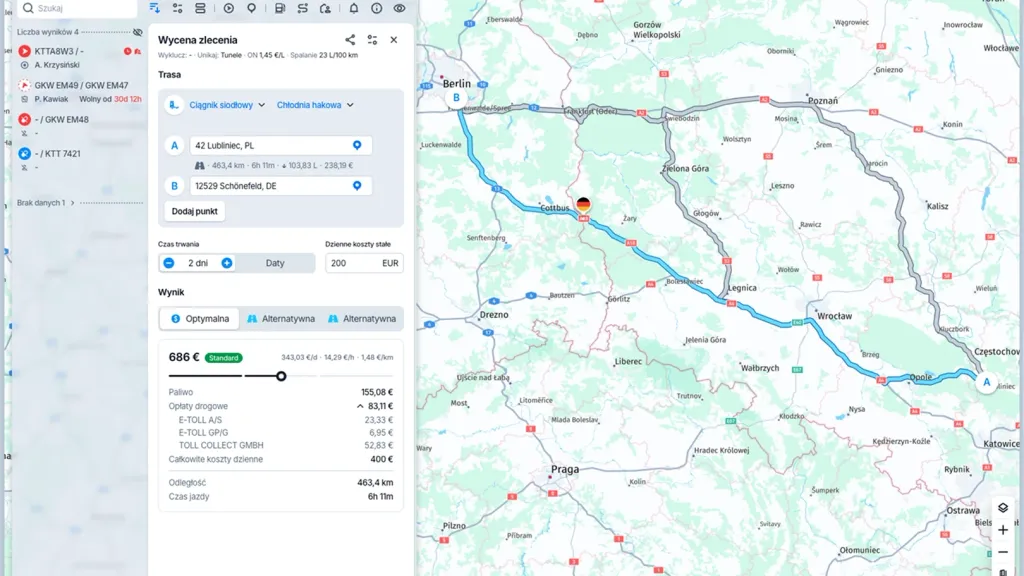
- Precision down to the last cent: Our calculator automatically calculates road tolls, taking into account the unique regulations of each country - from the number of axles and weight to vehicle dimensions and Euro or CO2 emission class.
- The choice is yours: The system proposes several alternative routes. You decide whether you prefer to drive faster or cheaper, seeing the differences in travel time and final toll cost clearly.
- Your fleet at your fingertips: You can save your vehicles in the system. This way, you don’t have to enter parameters every time - just select a specific truck, and the calculator adjusts the rates to its specification.
- Real-time cost optimization: By seeing the total toll cost before sending a truck on the road, you can better price the freight and avoid orders that are simply unprofitable at current rates.
Test it for free and without obligation. We believe in simple solutions, which is why we offer a free trial period so you can see how the calculator handles your most frequent routes. No “catches” or hidden commitments.
Want to see how it works in practice? Contact us for more details - we will set up your access in minutes.
Hidden Cost: Exchange Rates and Margins
Bulgaria is a country where the currency is the Lev (BGN). Although the BGN rate is strictly pegged to the EUR (1 EUR ≈ 1.95 BGN), a foreign carrier settling in a different currency often faces double conversion.
What to look for when choosing a road toll provider?
Many operators add a hidden margin to the exchange rate. When crossing the entire country (e.g., from the Romanian border at Ruse to the Turkish border at Kapitan Andreevo), road tolls are substantial. If your operator adds a 3-4% margin on the BGN/PLN or BGN/EUR rate, you are effectively paying an “extra tax” that isn’t visible at first glance. By choosing a system like OMV Smart Pass, you gain transparency - infrastructure fees are invoiced according to clear rules, making cost auditing easier.
Critical Infrastructure: Bridges and Ferry Crossings
Bulgaria is not just about motorways. Key elements of the route are the bridges over the Danube connecting Bulgaria with Romania:
- Danube Bridge I (Ruse - Giurgiu)
- Danube Bridge II (Vidin - Calafat)
Fees for these bridges are often charged separately. Modern road management systems allow for cashless settlement of these crossings. It is worth ensuring that your road toll solution supports these points so that the driver does not need to have cash in local currency.
Fuel in Bulgaria: “The Gateway to Turkey”
Bulgaria often offers some of the most attractive diesel prices in this part of Europe, making it an ideal place for a “full tank” before entering more expensive Greece or demanding Turkey.
Fuel Card for Heavy Vehicles in Bulgaria
Using a fuel card for heavy vehicles in Bulgaria (e.g., OMV) brings three main benefits to a transport company:
- Safety and Quality: The OMV network in Bulgaria is famous for high fuel standards (e.g., Diesel with refining additives), which is key for protecting DPF filters in modern Euro VI engines.
- VAT Refund from Bulgaria: Bulgarian fuel invoices entitle you to recover VAT. A professional fuel card provider offers a “net invoicing” service, which immediately improves the company’s financial liquidity.
- Expense Control: One card for fuel and one system for roads (Smart Pass) allow the owner to have full insight into the costs of a specific freight on the Balkan route.
OMV Smart Pass vs. OMV Fuel Card
It is important to understand the functional difference between these two tools to better manage your company:
- OMV Smart Pass: This is your tool for “fighting” infrastructure costs. It handles Bulgaria tolls, bridges, tunnels, and selected parking lots. It focuses on making sure the vehicle crosses the toll route legally and cheaply.
- OMV Fuel Card: This is an energy tool. It is used to purchase diesel, AdBlue, and operating fluids. It provides access to attractive fuel rates on the Bulgarian market, which is one of the key operational markets for OMV in the region.
Educational Checklist for Company Owners (Bulgaria Route 2026):
- Verify the vehicle’s CO2 class: In 2026 in Bulgaria, an incorrect declaration in the BG Toll system risks high fines imposed by “National Toll Administration” mobile patrols.
- Check the exchange rates at the operator: Are you paying for the transit through Bulgaria at a fair rate or with a high spread?
- Plan refueling: Bulgaria has a dense OMV network on main corridors (A1 Trakia, A2 Hemus). Refueling in Bulgaria is usually more profitable than in Romania or Greece.
- Integrate systems: Using EETS (Smart Pass) in Bulgaria allows you to receive one invoice for transit through multiple countries (e.g., Hungary, Romania, Bulgaria), which drastically simplifies accounting.
Summary
Effective transport to Bulgaria in 2026 is no longer just about finding good freight, but about eliminating financial “leaks.” Utilizing specialized tools - OMV Smart Pass for road tolls and infrastructure and OMV fuel cards to optimize diesel costs - allows for full control over the budget in this dynamic region.
Is your fleet ready for the Bulgarian BG Toll?
Contact our expert to compare your current conversion costs and road tolls in Bulgaria with the Smart Pass solution. Optimization begins with reliable data.