
Austria has for years served as a key transit country, connecting Northern Europe with Italy and the Balkans. However, for a transport company owner, “transit through Austria” is synonymous with high operational costs and a dense network of special fees. In 2026, with the full implementation of EU directives regarding CO2 emission-dependent charges, the GO-Maut system has become even more precise.
How to optimize the costs of crossing the Alps? Why is Austria a market where choosing the right fuel and road service provider matters most for your margin? Here is a detailed analysis.
System GO-Maut 2026: What changed in tolls?
In Austria, the state-owned company ASFINAG is responsible for toll collection. The system for vehicles over 3.5 tons (GO-Maut) is based on microwave technology (DSRC) but is fully compatible with the European EETS standard. In 2026, rates are adjusted not only for inflation but primarily based on the degree of decarbonization of the fleet.
Table 1: Factors determining toll rates in Austria (2026)
| Parameter | Impact on cost | Technical details |
|---|---|---|
| Number of axles | Very high | Categories: 2 axles, 3 axles, 4+ axles (most expensive). |
| CO2 emission class | Key in 2026 | Divided into 5 classes. Class 5 (emission-free) with the highest discounts. |
| EURO norm | High | Vehicles below Euro VI are burdened with drastic surcharges for air pollution. |
| Time of day | Medium | Higher rates apply at night (22:00 - 05:00) on selected sections (noise protection). |
An important aspect is section tolls (Streckenmaut). Even if you have an active on-board unit, traveling through points such as the Brenner Pass (A13), the Arlberg Tunnel (S16), or the Tauern Motorway (A10) involves additional, significant costs that are added to the consolidated invoice.
Table 2: Detailed breakdown of toll rates in Austria
| Vehicle weight | Axles | A (Euro 6) | B (Euro 5/EEV) | C (Euro 4) | D (Euro 3) | E (Euro 2) | F (Euro 1/0) |
|---|---|---|---|---|---|---|---|
| < 3.5 t, light commercial | 2 | € 0.20 | € 0.21 | € 0.22 | € 0.23 | € 0.23 | € 0.24 |
| 3.5-7.49 t | 2 | € 0.26 | € 0.27 | € 0.28 | € 0.29 | € 0.29 | € 0.30 |
| 7.5-11.99 t | 2-3 | € 0.36 | € 0.38 | € 0.38 | € 0.40 | € 0.40 | € 0.42 |
| 12-18 t | 2-3 | € 0.36 | € 0.38 | € 0.38 | € 0.40 | € 0.40 | € 0.42 |
| > 18 t | ≤ 3 | € 0.36 | € 0.38 | € 0.38 | € 0.40 | € 0.40 | € 0.42 |
| > 18 t | 4 | € 0.53 | € 0.56 | € 0.57 | € 0.59 | € 0.60 | € 0.61 |
| > 18 t | ≥ 5 | € 0.53 | € 0.56 | € 0.57 | € 0.59 | € 0.60 | € 0.61 |
Meet our Route Calculator
You already know the rates and what to look out for regarding currency conversions, but manually calculating costs for a route spanning thousands of kilometers is a direct path to errors. That is why we provide you with a tool that does it for you.
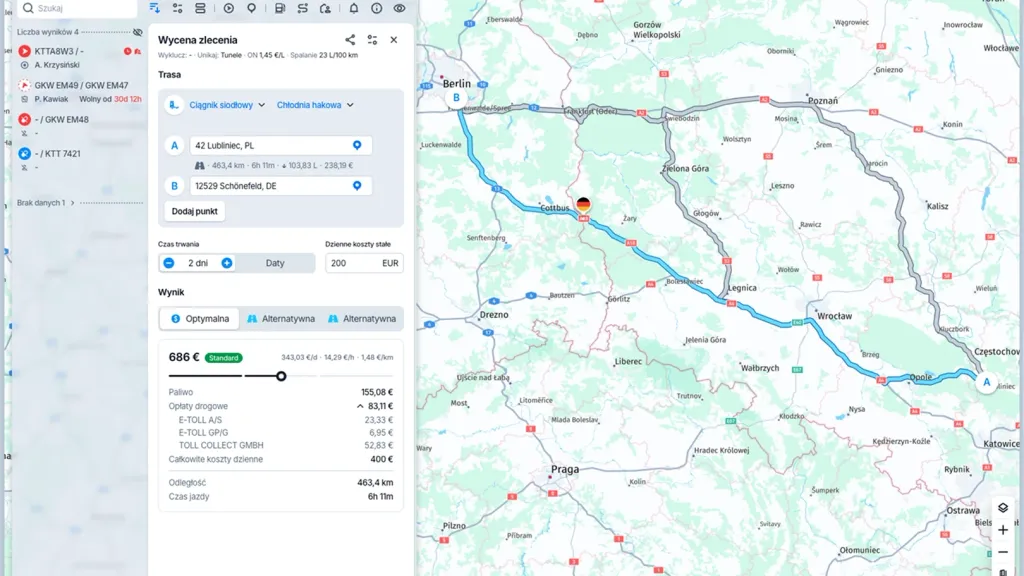
- Precision to the cent: Our calculator automatically calculates road tolls, taking into account the unique regulations of each country - from the number of axles and weight to vehicle dimensions and Euro or CO2 emission class.
- The choice is yours: The system proposes several alternative routes. You decide whether you prefer to drive faster or cheaper, seeing the differences in travel time and final toll cost clearly.
- Your fleet at your fingertips: You can save your vehicles in the system. This way, you don’t have to enter parameters every time - just select a specific truck, and the calculator adjusts the rates to its specification.
- Real-time cost optimization: By seeing the total toll cost before sending a truck on the road, you can better price the freight and avoid orders that are simply unprofitable at current rates.
Test it for free and without obligation. We believe in simple solutions, which is why we offer a free trial period so you can see how the calculator handles your most frequent routes. No “catches” or hidden commitments.
Want to see how it works in practice? Contact us for more details - we will set up your access in minutes.
Fuel in Austria: A Strategic Refueling Point
For many carriers, Austria is a “safe haven” in terms of fuel quality and price predictability. In 2026, due to local regulations and an extensive refining infrastructure, diesel prices in Austria remain competitive compared to neighboring Germany or Switzerland, provided that appropriate fleet tools are used.
The price of diesel in Austria 2026 is strongly correlated with the carbon tax, but for transport companies, the key savings mechanism is the refund of VAT and excise duty (EUAUL).
OMV Fuel Card: Advantage in the Home Market
Austria is the home market of the OMV group. For a transport company owner, this means that the OMV fuel card offers conditions in this country that are hard to find through intermediaries.
- Network Density: Access to high-standard OMV stations located directly on major transit routes.
- Fuel Quality: High-performance diesel (e.g., OMV MaxxMotion), which in the difficult, mountainous terrain of Austria realistically translates into lower fuel consumption under load.
- Price Optimization: Direct access to wholesale rates and transparent discounts that are not “eaten up” by subcontractor margins.
- Driver Infrastructure: Austrian OMV stations are often logistics centers with high-level parking, showers, and catering, which makes it easier for drivers to comply with working time regulations.
OMV Smart Pass: Intelligent Infrastructure Management
As in Germany, it is recommended in Austria to separate financial flows for fuel and roads. OMV Smart Pass is a dedicated solution for handling road infrastructure only. In 2026, when ASFINAG strictly monitors CO2 emission classes, having a specialized system is crucial.
Why choose Smart Pass in Austria?
- Handling Special Fees: Smart Pass automatically settles not only standard motorway kilometers but also the previously mentioned tunnels and bridges (Streckenmaut), eliminating the need for cash or card payments by the driver at the booths.
- Currency Transparency: Settlements for Austrian roads take place in EUR. For foreign companies, Smart Pass offers transparent conversion mechanisms, which avoids the hidden costs of currency spreads, which can amount to hundreds of euros per month per vehicle at Austrian toll rates.
- Easy VAT Refund: Thanks to the clear reports from the Smart Pass system, the process of recovering Austrian VAT on road tolls is much faster and carries a lower risk of formal errors.
What to watch out for in Austria? Expert Tips
Passing through Austria is not only about costs; it is also about strict inspections. In 2026, inspectors focus on three areas:
- Correctness of CO2 Class: Incorrectly declaring the emission class on the on-board unit risks a fine amounting to thousands of euros. It is worth ensuring that your EETS provider (e.g., through Smart Pass) has the current technical data of your fleet.
- Driving Bans: Austria has unique bans (e.g., a night driving ban for vehicles that do not meet the Lärmarm, i.e., “silent” vehicle, standard).
- Vignettes and Special Sections: Some lower-class roads in Austria are excluded from the electronic system and require separate permits - always verify the route in the planning system before sending a driver.
Summary: How to win on Austrian routes?
In 2026, the key to profitability in transport through Austria is the synergy of two tools from the market leader:
- OMV Fuel Card: For the lowest fuel prices, highest quality diesel, and full support in the group’s home market.
- OMV Smart Pass: For seamless and transparent settlement of tolls, tunnels, and bridges without hidden currency costs.
Separating these two services allows for precise monitoring of company KPIs and quick reaction to rising transport costs. In Austria, a country with some of the highest road rates in Europe, every percentage of savings on currency margins or fuel discounts realistically builds your competitive advantage.
Want to see how much you can reduce the cost of transport through Austria?
Take advantage of the knowledge of OMV experts in their home country. Order an analysis of your fleet in terms of CO2 emission classes and see how optimizing infrastructure payments with Smart Pass will affect your financial result. Contact an advisor today - it is the first step toward peaceful transit through the Alps.