

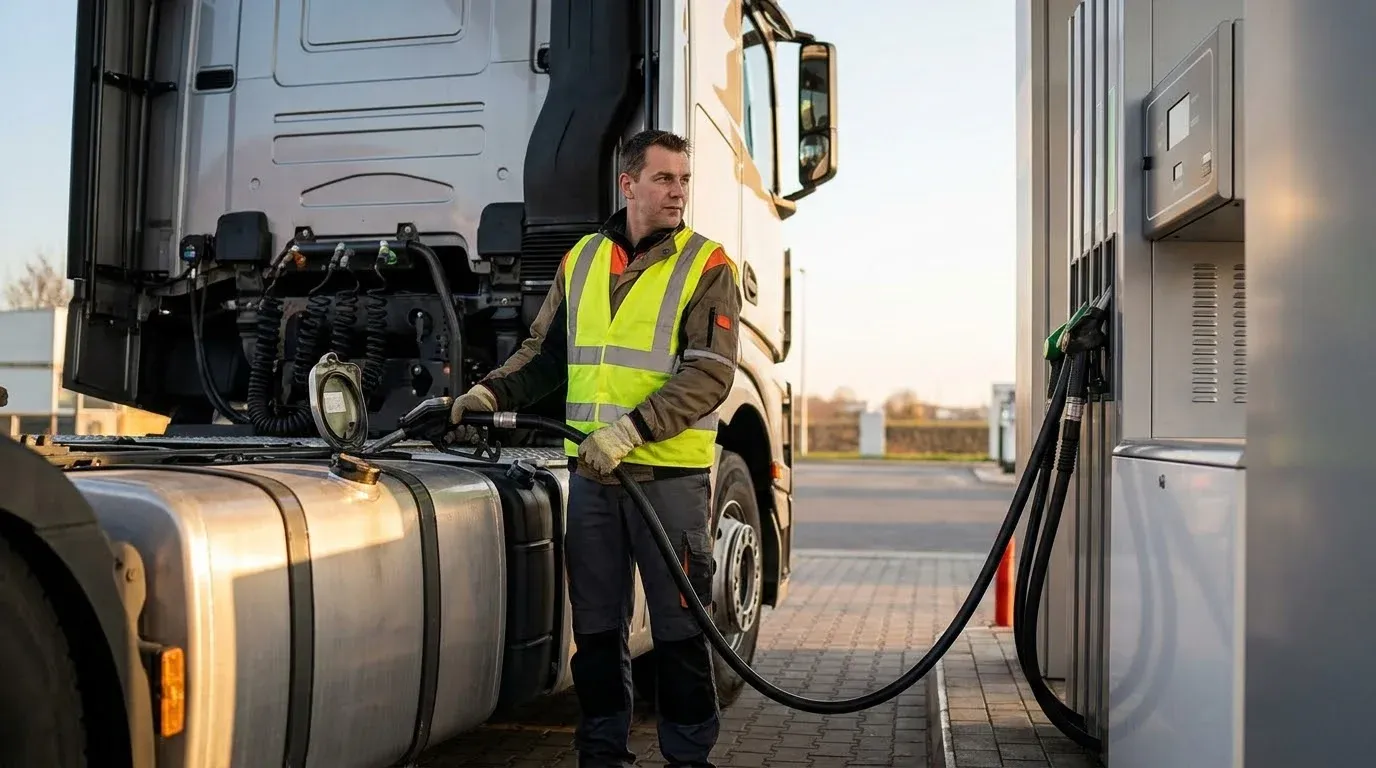
A fuel card is a company card for paying for fuel and station services without cash. The driver fills up and confirms the purchase with a PIN, and the company gets one consolidated invoice for the whole billing period.
For a fleet, that means fewer receipts, limits on every card and a full view of every fill-up. This guide explains how it works for trucks on long international routes, for example from Poland through Germany to France.
Costs and issuer comparisons have their own guides, linked in the text. Companies based in Poland can check the terms of the fuel card for international truck fleets that ONYX offers.
What is a fuel card and what can you pay for with it?
A fuel card is a payment card issued to a company and assigned to a vehicle or a driver. You pay with it at stations in the acceptance network and settle later, against an invoice from the card issuer. It is also called a fleet card.
Compared with an ordinary company card, two things set it apart:
- Assigned to a truck or driver. The invoice shows which tractor unit filled up, where and how much.
- Limits. You set an amount, a number of litres or a fuel type for each card.
Depending on the offer, the card also covers AdBlue, truck washes or parking. Card prices and the services of the OMV card are covered in our guide to fuel cards for companies. Tolls usually go through a separate on-board unit, covered on our road tolls page.
You will find two main types of card on the market:
| Card type | Where you fill up | What to check |
|---|---|---|
| Single-network card | At the stations of one fuel company | Whether that network’s stations sit on your routes |
| Multi-network card | At partner stations of several brands | How acceptance differs between countries |
The line is not always sharp. OMV cards work mainly at OMV’s own stations, and the ROUTEX function adds partner stations. E100, Eurowag and DKV are built on partner networks of many brands, as our fuel card comparison for HGV fleets shows.
Which model fits depends on your routes. How to test it on your own data is covered below, in What should you check before signing a fuel card contract?
How does a fuel card work, step by step?
A fuel card works in five steps, from the contract with the issuer to the consolidated invoice. Each step leaves a record in the system, so you know who filled up, where and how much.
- Contract and limits. You sign with the issuer and agree the billing period, payment term and fleet limits.
- A card for each truck or driver. Each card carries the tractor unit’s registration number or the driver’s name. Every card gets its own PIN.
- Fill-up with a PIN. The driver fills up at a station in the acceptance network and confirms with the PIN, often adding the odometer reading.
- Transaction logged in the portal. The date, station, country, litres and amount go into the issuer’s online portal.
- Consolidated invoice. After the billing period, one invoice covers all cards, payable on the contract term.
Issuers usually give you an online portal. In it you see every card’s transactions, block a lost card and change limits without calling your account manager.
The odometer reading entered at the pump usually goes into the report next to the litres. From those two numbers you work out each truck’s consumption between fill-ups.
A wrong reading skews that result, so compare it once a month with the mileage from the tachograph or telematics.
Example: a truck runs from Antwerp to Budapest. The driver fills up in Germany and in Austria, and the portal shows both, with country, station and litres.
What are the benefits of a fuel card for a fleet?
With a fuel card, the company pays for fuel in one batch and later, not at every fill-up. For a fleet owner, the main gain is order in fuel costs and less work in the office.
Limits and the transaction list show how much each vehicle uses. One invoice replaces a stack of receipts, and drivers carry no cash, so you stop settling advances after every trip. How the contract’s payment term affects cash flow is covered in our article on fuelling cheaply, in the section on deferred payment.
Fuel card for trucks: how is it different in heavy haulage?
A truck fuel card works the same way as a card for cars, but different things decide its value. For an HGV fleet, what counts is stations for heavy vehicles, the countries on the route, card settings for drivers on long trips and how foreign VAT and excise are settled.
Station network for trucks
An articulated truck needs a station with an HGV pump, a high canopy and room to manoeuvre. Not every station in a card’s acceptance network meets those conditions.
On the issuer’s map, filter for truck stations rather than every acceptance point. Mark the stations with truck parking too, because drivers often combine a fill-up with a break or a daily rest.
Fuelling abroad
One card works in many countries, but acceptance differs between networks and states. A card with a dense network on your route through Germany may have fewer truck stations further south and east.
Check acceptance in every transit country, not only in the country of unloading. For the south-east, see our guides for the Czech Republic, Slovakia and Hungary.
Agree with your dispatchers where drivers fill up on regular routes. A fuelling plan lets the driver pick a station in the card’s network instead of paying at the first station when the tank runs low.
A card per truck or per driver?
A card assigned to a tractor unit stays in the cab when drivers change. The report then shows the consumption of that truck, which makes it easier to compare vehicles in the fleet.
A card assigned to a driver travels with them, even when they switch to another tractor at the depot or on the road. Then the vehicle number and odometer reading entered at the pump matter, because without them you cannot match the fill-up to a truck.
Limits for long trips
A limit set too low stops the driver at a station halfway through the trip, and one set too high does little against misuse. Match the daily litre limit to the tractor’s tank size, and the monthly amount to the usual mileage on that route.
Restrict purchases to what a truck needs: diesel, AdBlue and, if you want, washes. Before an unusual trip, you can usually raise the limit in the portal, with no new card.
A lost card abroad
Agree a simple routine with drivers for a lost card: a call to the dispatcher, a block in the portal and an order for a new card. The driver should carry the issuer’s helpline number, kept separately from the card.
Decide in advance how the driver pays for fuel until the new card arrives. A set rule shortens the stop when the problem comes up in a transit country.
Net invoicing
When you fill up abroad, the price includes the VAT of the station’s country, which a company established in the EU recovers through an electronic refund application filed in its own member state, under Directive 2008/9/EC. In some countries, issuers bill fuel net, without local VAT, and VAT deduction from card invoices is covered in our article on fuelling cheaply, in the section on VAT deduction.
Excise refund
EU member states may apply a lower excise rate to diesel used to carry goods in vehicles with a maximum permissible gross weight of at least 7.5 tonnes (Directive 2003/96/EC, Article 7), and some do this by refunding part of the excise duty to the haulier. Countries, conditions and the documents a claim needs are in our article on excise refunds and net invoicing on a fuel card.
What should you check before signing a fuel card contract?
There is no single best fuel card. The right one depends on your fleet’s routes, countries and the way you settle fuel costs.
The general criteria, from cost on your routes to local support, are set out in the criteria section of our fuel card comparison. The checklist below applies them to your own fleet data.
A seven-step checklist
- Collect your fill-ups from the last few months. List countries, stations and litres from receipts or your current card’s portal. This is your baseline.
- Lay them over the issuer’s station map. Mark the stretches with no truck stations, especially in transit countries.
- Ask about net invoicing and excise. Request the list of countries on your routes where the issuer bills net and helps with excise refunds.
- Price the offer on your own litres. Recalculate the last few months on the offer’s terms, with fees and currency conversion. One rate from a sales deck will not show what you pay on your routes.
- Read the contract. Check the billing period, payment term, credit limit, card fees and notice terms.
- See the portal. Ask for a demo of per-card limits, card blocking and data export to your accounting.
- Plan the switch. Set the billing period from which you move to the new card, so no driver is left on the road without one.
How do you get a fuel card?
You get a fuel card after you sign a contract with an issuer or its agent. The process usually looks like this:
- Choose an issuer. Match the station network and countries to your routes.
- Apply. You give your company details, VAT number, the number of vehicles and the number of cards you need.
- Checks and contract. The issuer usually checks the company against its registration documents. Then it sets a credit limit and the payment term.
- Cards and PINs. You receive cards assigned to vehicles or drivers, with the PINs sent separately.
Timing depends on the issuer and your paperwork. Order cards for every truck that drives abroad at once, so no driver pays cash on the first trip.
ONYX is an official OMV agent and handles OMV fuel card applications from companies based in Poland only, with invoices payable within up to 30 days. If your company is registered in another country, apply directly with the issuer or with its agent there.
Is a fuel card worth it?
A fuel card pays off when the company fills up regularly and drives through several countries. Then one invoice, limits and a payment term save office time and keep costs in order.
Do not judge the value by one rate in an offer. Check the whole contract: fees, payment term, the station network on your routes, and how VAT and excise are settled.
Even for one truck, a card replaces cash and receipts. A larger fleet adds limits for each truck, portal reports and tax refund claims.
Other ways to cut fuel cost, such as choosing where you fill up, are in our article on how to fuel cheaply in a transport company.
Summary
A fuel card is a company card for cashless fuelling, with one consolidated invoice, limits and a payment term. Across borders, truck stations, route countries, card settings for drivers, and VAT and excise settlement count too.
If your trucks fill up in several countries, compare offers on data from your own routes. Fees, discounts and excise refunds are explained step by step in the full guide.
Sources
| Source | What it covers | Link |
|---|---|---|
| EUR-Lex | Directive 2003/96/EC: taxation of energy products, commercial gas oil | Directive 2003/96/EC |
| EUR-Lex | Directive 2008/9/EC: VAT refunds to businesses from another EU country | Directive 2008/9/EC |
| European Commission | Excise duties on energy, including minimum rates for commercial gas oil | taxation-customs.ec.europa.eu |
| OMV | OMV fleet cards and the ROUTEX function | omv.com |