Skip to content

Transport order template: free download (PDF and Word)

This transport order template is an editable order from shipper to carrier for road transport. Download Word to edit or PDF to print, in two versions: international carriage under the CMR Convention and domestic carriage within Poland.

Download the template

Domestic carriage (Poland)

International carriage (CMR)

  • A4 format
  • No form, no sign-up

The template is for information only and is not legal advice. Legal position as at 14 November 2026. Adapt it to your situation before use, and consult a lawyer in unusual cases. ONYX is not liable for the consequences of using the template, to the extent permitted by law.

See how to fill in each field
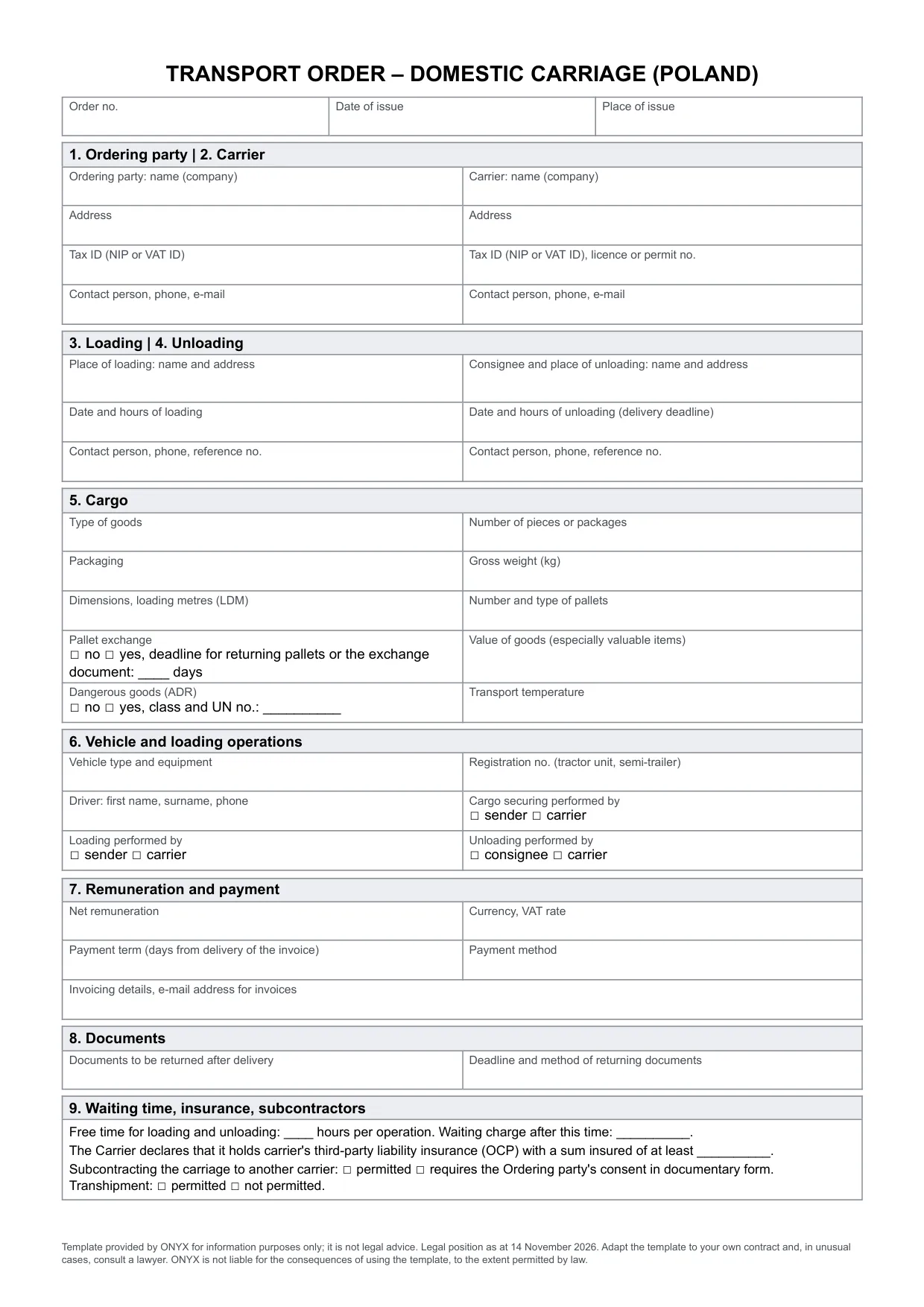
Transport order template to download: page one with the fields for the ordering party, carrier, loading, unloading, cargo, vehicle, remuneration and documents

What should a transport order contain?

A transport order, also called a carriage order, is the document in which the ordering party records the terms of the contract of carriage and sends them to the carrier. By a contract of carriage the carrier undertakes to carry goods for remuneration (Article 774 of the Civil Code). The parties therefore agree who the ordering party and the carrier are, what goods are carried, from where to where, and the carrier's remuneration.

Under Polish law, no provision sets the content of a transport order. The statutes set the content of the consignment note and the information the sender gives the carrier. The parties and market practice shape the content of the order, within the limits of mandatory rules.

  • Parties

    Ordering party and carrier: the name and address of each company.

  • Cargo

    The type of goods the carrier is to carry.

  • Route

    Place of loading and place of unloading.

  • Remuneration

    The freight the carrier receives for the carriage.

How to fill in the transport order form, field by field

The fields follow the order of the template, the same in the editable Word file and in the PDF. Each field shows its label and the reason to fill it in.

essential term
An essential term of the contract: without agreement on it, no contract of carriage is made.
recommended
A statute attaches legal effects to this information or requires it in the consignment note.
common practice
A field used in the market, with no basis in statute.

No statute requires any field in a transport order. In the template we mark the essential terms of the contract (parties, cargo, route, remuneration), recommended fields and fields used in practice.

Header

Order no., date and place of issue
common practice
Lets you refer to the order without doubt. The CMR Convention provides for the date and place of issue in the consignment note, not in the order.

1.Ordering party

Name (company) and address
essential term
The ordering party is a party to the contract of carriage (Article 774 of the Civil Code). The sender gives the carrier its own address (Article 779 of the Civil Code).
Tax ID (NIP or VAT ID)
common practice
Used for the invoice and for settlement.
Contact person, phone, e-mail
common practice
Shows whom to contact about changes and the order confirmation.

2.Carrier

Name (company) and address
essential term
The carrier is the other party to the contract of carriage (Article 774 of the Civil Code).
Tax ID (NIP or VAT ID), licence or permit no.
common practice
The Polish Road Transport Act (ustawa o transporcie drogowym) sets a penalty for ordering carriage from a company without the required permit. The number in the order helps you check it.
Contact person, phone, e-mail
common practice
Shows whom to contact about changes and the order confirmation.

3.Loading

Place of loading: name and address
essential term
Starts the route of the carriage. Without the place of loading the carrier does not know where to collect the cargo.
Date and hours of loading
recommended
Needed in practice in every order. The hours are common practice.
Contact person, phone, reference no.
common practice
Speeds up arrangements at the loading dock and lets the site find the load by its number.

4.Unloading

Consignee: name and address
recommended
The sender gives the carrier the consignee's address (Article 779 of the Civil Code). The consignee also goes into the consignment note.
Place of unloading
essential term
Ends the route of the carriage. The sender gives the carrier the place of destination (Article 779 of the Civil Code).
Date and hours of unloading (delivery deadline)
recommended
The carrier delivers the consignment within the agreed time (Article 49 of the Transport Law). The agreed date sets when delay starts.
Contact person, phone, reference no.
common practice
Speeds up arrangements at the loading dock and lets the site find the load by its number.

5.Cargo

Type of goods
essential term
The goods are the object of the contract of carriage (Article 774 of the Civil Code).
Number of pieces or packages
recommended
The sender gives the carrier the quantity (Article 779 of the Civil Code). It also goes into the consignment note.
Packaging
recommended
Packaging is the sender's duty (Article 41 of the Transport Law), and the sender tells the carrier how the goods are packed (Article 779 of the Civil Code).
Gross weight (kg)
recommended
It goes into the consignment note. When the weight stated in the note is false, the sender pays the reloading costs (Article 72 of the Transport Law).
Dimensions, loading metres (LDM)
common practice
Help the carrier choose the vehicle and the load space.
Number and type of pallets
common practice
States how many pallets of which type the carrier takes for carriage.
Pallet exchange
common practice
Pallet exchange rules and the return deadline apply only when the parties write them into the order.
Value of goods (especially valuable items)
recommended
As a rule, the carrier is liable for especially valuable items only when their nature was stated when the contract was made (Article 788 § 3 of the Civil Code).
Dangerous goods (ADR)
recommended
The Transport Law accepts dangerous goods for carriage only on special conditions (Article 36 of the Transport Law).
Transport temperature
common practice
States the temperature range when the load travels in a reefer.

6.Vehicle and loading operations

Vehicle type and equipment
common practice
The carrier must use a vehicle suitable for the carriage (Article 3 of the Transport Law). The description in the order says which vehicle you expect.
Registration no. (tractor unit, semi-trailer)
common practice
Lets the site recognise the vehicle at loading.
Driver: first name, surname, phone
common practice
Gives you direct contact on the road.
Cargo securing performed by
recommended
The entry settles who secures the cargo on the vehicle.
Loading performed by
recommended
Unless the contract says otherwise, loading falls to the sender or the consignee (Article 43 of the Transport Law). The order can change this split.
Unloading performed by
recommended
By default, unloading falls to the consignee (Article 43 of the Transport Law). The entry shows whether the carrier does it.

7.Remuneration and payment

Net remuneration
essential term
The carrier carries the goods for remuneration (Article 774 of the Civil Code), so the freight amount is the basis of the contract.
Currency, VAT rate
recommended
The currency completes the agreement on remuneration. The VAT rate is settlement practice.
Payment term (days from delivery of the invoice)
recommended
Between businesses, the payment term as a rule cannot exceed 60 days from delivery of the invoice (Article 7(2) of the Act on Counteracting Excessive Delays in Commercial Transactions).
Payment method
common practice
No statute sets it. Most often it is a bank transfer to the account on the invoice.
Invoicing details, e-mail address for invoices
common practice
The payment term runs from delivery of the invoice, so state where to send it.

When the term is longer than 30 days, a creditor that is not a large enterprise may claim statutory interest after 30 days (Article 5 of the Act on Counteracting Excessive Delays in Commercial Transactions). When a large enterprise pays and the creditor is a micro, small or medium-sized enterprise, the term cannot exceed 60 days (Article 7(2a) of that Act).

8.Documents

Documents to be returned after delivery
common practice
No statute sets what the carrier sends back after delivery. A list in the order removes doubt.
Deadline and method of returning documents
common practice
No statute sets this deadline, so the one written in the order applies.
Customs instructions (international template only)
recommended
The sender gives the carrier the documents needed for customs clearance (Article 782 of the Civil Code). The CMR Convention provides for customs instructions in the consignment note.

9.Waiting time, insurance, subcontractors

Free time for loading and unloading, waiting charge
common practice
The Transport Law and the CMR Convention set no waiting-time rates and no pallet exchange rules. These terms apply when the parties write them into the order.
Carrier's third-party liability insurance (OCP)
common practice
The Road Transport Act does not list OCP insurance among the conditions for a permit to work as a road carrier. In practice the ordering party requires it, so the template has a field for the sum insured.
Subcontracting the carriage to another carrier
common practice
Unless the contract forbids it, the carrier may entrust the carriage to another carrier and stays liable for the whole carriage (Article 789 § 1 of the Civil Code). Write any consent requirement into the order.
Transhipment
common practice
The entry settles whether the goods may change vehicle on the way.

10.Remarks and additional instructions

Remarks
common practice
The Transport Law bans conditions whose performance could breach the rules on drivers' working time or road traffic (Article 55a of the Transport Law).

11.Terms of carriage

Domestic template: domestic carriage
common practice
Names the Transport Law and the Civil Code as the basis of the carrier's liability.
International template: international carriage (CMR)
recommended
The CMR Convention provides for a statement in the consignment note that the carriage is subject to it. If the statement is missing, the carrier bears the risk.
Changes to the order in documentary form
common practice
A contract of carriage needs no special form. A change recorded in an e-mail, for example, is easier to prove in a dispute.

12.Confirmation of acceptance of the order

Ordering party: date, first name and surname, signature
recommended
A signature is not a condition of the order's validity. It makes the terms easier to prove in a dispute.
Carrier: date of confirmation, first name and surname
recommended
Records when and by whom the carrier accepted the order.
Signature of the Carrier or the e-mail address from which the confirmation was sent
recommended
An order accepted by e-mail validly concludes the contract, even without a signature. The e-mail address shows who confirmed it.

CMR transport order template or domestic template: choose your version

The law does not require separate order templates for domestic and international carriage. The legal regime differs: domestic carriage is governed by the Polish Transport Law and the Civil Code, international carriage by the CMR Convention. That is why we provide two templates. They differ in the terms of carriage in section 11 and in the field for customs instructions.

Domestic template (Poland)

When to choose it
Loading and unloading in Poland
For example, Gdańsk → Rzeszów.
Governing rules
Transport Law and Civil Code
These rules set the carrier's liability for loss of, shortage in or damage to the consignment and for delay in delivery.
Transport document
Consignment note
Article 38 of the Transport Law sets the content of the consignment note.

International template (CMR)

When to choose it
Loading and unloading in two different countries
For example, Poznań → Lyon.
Governing rules
CMR Convention
In international carriage, the parties cannot change by contract the carrier's liability rules set by the CMR Convention. A clause that breaches the Convention is void, and the rest of the contract stays in force (Article 41 of the CMR Convention).
Transport document
CMR consignment note or e-CMR
With a statement that the carriage is subject to the CMR Convention.

The templates do not cover cabotage, that is carriage entirely inside another country. The law of that country governs such carriage.

Transport order or CMR consignment note?

A transport order and a CMR consignment note are two different documents. The order holds the terms of the contract, and the CMR note confirms that the contract was made and the goods were taken over. The CMR Convention sets the particulars of the consignment note (Article 6) and puts no requirements on the content of the order.

What the template leaves out, and why

We left out some clauses you may know from other orders on purpose. Here is why, and what to do if you need them.

  • Contractual penalties

    In international carriage, the CMR Convention governs the carrier's liability for delay in delivery. Polish common courts have held contractual penalties for delay in delivery in such carriage to be void, so the template does not contain them. Contractual penalties for other breaches, for example for failing to provide the vehicle, are allowed, but a court may reduce them when they are grossly excessive. The template does not contain these penalties either. If you need them, agree the wording with a lawyer.

  • “No reply means acceptance”

    A clause such as “no refusal within 30 minutes means acceptance” does not bind a carrier the ordering party does not work with regularly; Polish common courts have refused to give it effect. Instead of such a clause, section 12 of the template has a field for the carrier's confirmation of acceptance.

  • Choice of court clause

    The template does not name the court that decides disputes between the parties, because the choice of court depends on what the parties agree. If you need such a clause, have a lawyer draft it.

  • Payment term counted from documents

    The template counts the payment term from delivery of the invoice, and you enter the number of days yourself. It does not make the term depend on delivery of the consignment note or other documents. If you want to link the term to documents, discuss such a clause with a lawyer.

  • Written form and signature requirement

    A contract of carriage needs no special form, so the template does not require written form. The carrier can confirm the order with a signature or by e-mail, and any change to the order requires documentary form (for example an e-mail).

  • Terms of use and legal note

How to send an order with the template

  1. Download the right template

    Choose the international template (CMR) when loading and unloading are in two different countries, or the domestic one when both are in Poland. Word is for editing on a computer, PDF for printing.

  2. Fill in the fields

    Start with the four essential terms: parties, cargo, route and remuneration. Then add dates, documents and the other terms.

  3. Check the terms of carriage

    Section 11 names the rules that govern the carriage. Check that the template you downloaded matches the route of the order.

  4. Send it and ask for confirmation

    Send the order by e-mail and ask the carrier to confirm acceptance in section 12. Keep the reply with the order.

Do you order transport every week?

In ONYX you add an order in your shipper account, with no middlemen and no commission. A verified carrier sees the route, the rate and the payment term before accepting the order.

Transport order template FAQ

Does a transport order need a signature?

A contract of carriage needs no special form. An order sent by e-mail or through a platform and accepted by the carrier validly concludes the contract, even without a signature. A signature and a confirmation of acceptance make the terms easier to prove in a dispute. That is why the template ends with a field for confirming acceptance of the order.

Does no reply from the carrier mean the order is accepted?

As a rule, the carrier's silence alone does not mean it accepts the order. The rule on silent acceptance of an offer (Article 68² of the Civil Code) covers a business that received an offer from a party it has a standing business relationship with and did not reply without delay. That is why the template provides for the carrier to confirm acceptance of the order.

What payment term should I write in the order?

The field in the template is empty. Enter the number of days counted from delivery of the invoice; between businesses, as a rule, no more than 60.

Can I use the template for international transport?

Yes. For carriage between two countries, download the international template (CMR). Its section 11 names the CMR Convention, and it has a field for customs instructions. The domestic template is for carriage entirely within Poland.

Is a transport order the same as a freight forwarding order?

No. A transport order concerns a contract of carriage: the carrier undertakes to carry the goods (Article 774 of the Civil Code). A freight forwarding order concerns a forwarding contract, governed by Articles 794–804 of the Civil Code. This template is for ordering carriage.

What format is the template in?

There are two templates: domestic and international (CMR). Each comes as a DOCX file to edit in Word or another word processor and as a PDF to print. The download is free and needs no registration or personal data.

Terms of use and legal note

The template is provided by ONYX sp. z o.o., Lubowidzka 33, 80-174 Gdańsk, KRS 0000158596, NIP 1181675617, e-mail contact@onyxtms.com.

Send comments and complaints about how the page works to contact@onyxtms.com.

The download is free and needs no registration or personal data. You need a program that opens DOCX or PDF files. You may download, change and use the template in your own business.

Legal note

The transport order template and its explanations are general information. They are not legal advice or a legal opinion and do not replace a consultation with an advocate or a legal adviser. They cover Polish law and the CMR Convention only. If another country's law governs your contract, check its rules.

We prepared the template according to the legal position as at 14 November 2026. Statutes and court rulings change, so check before use that the template is still up to date.

The template is a starting point. Every carriage is different: adapt the order to the goods, the route, the counterparty and what the parties agreed. In unusual cases, for example high-value goods, dangerous goods, cabotage or long-term cooperation, have a lawyer check the order.

We take care that the template and the explanations are reliable, but we do not guarantee that they are complete and suitable for every contract. To the extent permitted by law, ONYX sp. z o.o. is not liable for the consequences of using the template, including loss caused by using it without adapting it to the situation. We do not exclude liability that cannot be excluded by law, in particular for damage caused intentionally, or liability towards consumers to the extent the law does not allow it.

Statutes cited: Act of 8 March 2013 on Counteracting Excessive Delays in Commercial Transactions (ustawa o przeciwdziałaniu nadmiernym opóźnieniom w transakcjach handlowych; consolidated text, Journal of Laws (Dz.U.) 2023, item 1790); Act of 15 November 1984, Transport Law (Prawo przewozowe; consolidated text, Dz.U. 2024, item 1262, as amended); Act of 23 April 1964, Civil Code (Kodeks cywilny; consolidated text, Dz.U. 2026, item 795); Convention on the Contract for the International Carriage of Goods by Road (CMR) (Dz.U. 1962, no. 49, item 238, as amended; UN Treaty Series vol. 399, No. 5742).

Post your next order in ONYX. No middlemen.