

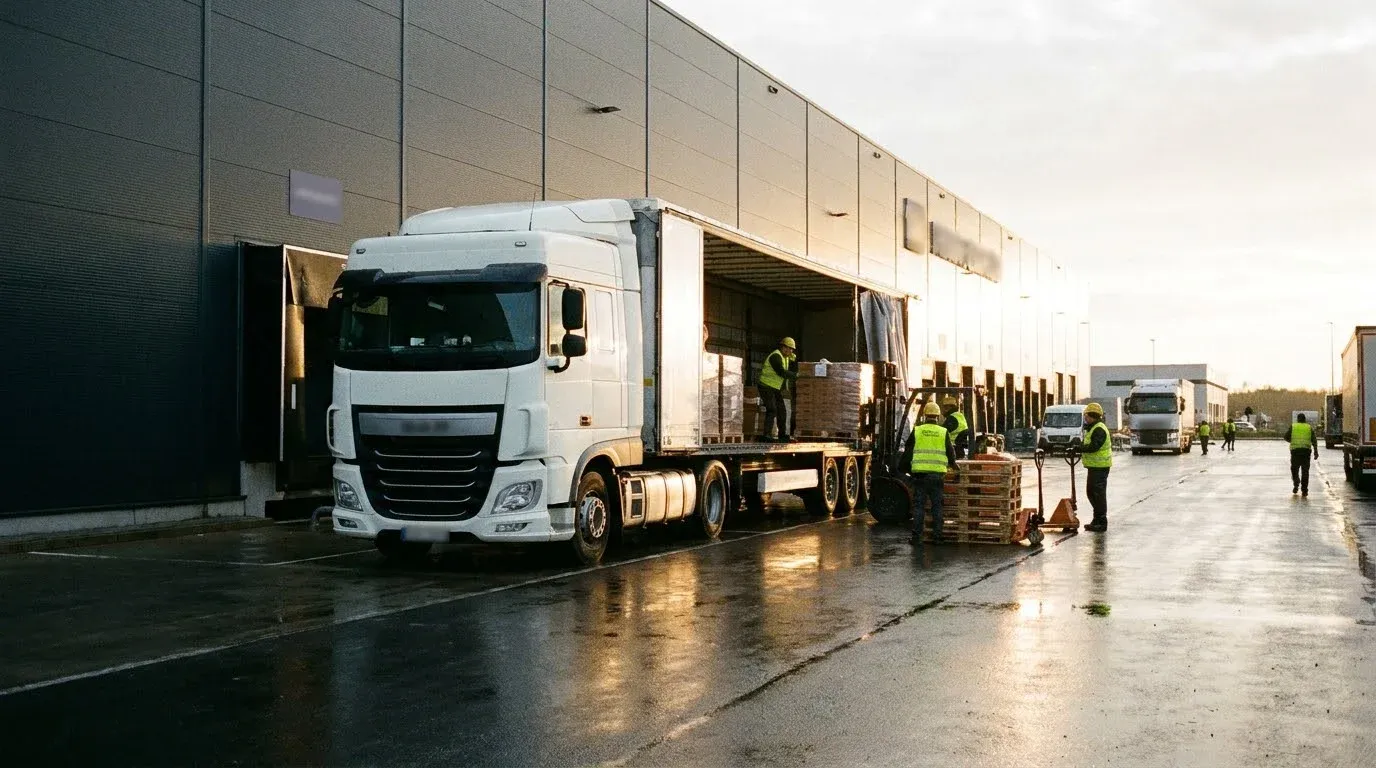
Curtainsider truck loads from Poland come from three places: a load board for tractor-trailers filtered by body type, shippers and forwarders, and transport orders assigned straight to a truck. Judge each source from the combination you drive.
Freight exchanges return long lists of offers, including FTL loads from Poland. This guide shows how to pick a load for a tractor unit with a curtainsider or tilt trailer on cross-border lanes that start in Poland.
You get a table of six parameters to check in every offer before you talk about the rate.
Curtainsider loads from Poland: what the offer means
A curtainsider load from Poland is freight for a tractor unit with a curtainsider or tilt trailer that loads in Poland. The offer is a full truck load or several part loads, and the driver needs a category C+E licence.
Polish offers call this combination a “tir”, the everyday Polish name for an articulated truck. Category C+E covers a category C vehicle with a trailer (gov.pl, driving licence categories, page in Polish), so C+E transport orders mean loads for the same combination.
“Tir” names the vehicle class, and the body type decides which goods fit. So look for two things in an offer: the size of the vehicle and the trailer type, for example “plandeka” (a tilt trailer), “firanka” (a curtainsider) or “chłodnia” (a reefer).
If an offer says only “tir”, ask about the body type and the loading method. Those two answers tell you whether your trailer is in the running.
A TIR carnet is a separate matter. It is an international customs transit document under which goods travel from a customs office in one country to a customs office in another (European Commission, customs transit).
Under the TIR system, goods travel in sealed load compartments under customs control (IRU). In a load offer, “tir” describes the truck, and a TIR carnet is a customs document.
Freight exchange for trucks: how to filter offers
A freight exchange for tractor-trailers is a load board view narrowed to loads for articulated trucks. You usually filter it by body type, weight and loading place.
Set four filters for your combination:
- Body type. Choose curtainsider or tilt. That leaves curtainsider loads only.
- Full or part load. A full truck load (FTL) takes the whole vehicle from one shipper. A part load (LTL, less than truckload) shares it with other loads.
- Weight. Set the upper limit to your payload.
- Pallet spaces or loading metres. Enter the floor you have free.
Region, loading date and saved searches for regular lanes, for example Łódź to Rotterdam, work as for any truck: our guide on how to find loads covers them.
Access cost and payment protection differ between platforms. See our comparison of four freight exchanges, and for free plans and trials the guide to free freight exchange options.
Curtainsider loads: what to check in an offer
A load fits a curtainsider when six things match: loading method, floor space, weight, dimensions, securing and type of carriage. Check them before you call about an offer.
A tilt trailer has a tarpaulin roof and sides. A curtainsider is a trailer whose sides slide open like a curtain.
On both, you open the side or the roof, so goods go in from the side, the top or the rear.
| Parameter | What to check | Why |
|---|---|---|
| Loading method | Side, top or rear. Ask what the shipper’s and the consignee’s ramps require. | The side opens, so a forklift can load where there is no ramp. |
| Pallet spaces or loading metres | The floor the goods take. An EPAL Euro pallet measures 800 × 1,200 mm (EPAL). | A loading metre (LDM) is one metre of floor length across the full trailer width. It decides whether more goods fit. |
| Weight of the goods | Gross weight with pallets and packaging, against the payload in the trailer’s registration document. | A loaded five or six-axle combination must stay within 40 tonnes in international traffic (Directive 96/53/EC). |
| Dimensions and height of the goods | The longest and tallest item, against your trailer’s internal dimensions. | Goods that extend beyond the trailer need separate arrangements before departure. |
| Securing | Straps, anti-slip mats and edge protectors: how many and who provides them. | The shipper’s trailer and equipment requirements are in the order. Confirm them before you send the truck. |
| Full or part load | The number and sequence of loading and unloading points. | A part load fits when the next unloading points lie on the way, for example from Wrocław to Lyon. |
Side loading needs yard space for a forklift at the trailer’s side. Top loading means an overhead or mobile crane, so confirm your roof slides open.
Work out loading metres on an example. An EPAL pallet is 800 mm on its short side, so two pallets placed side by side with the long side across the trailer take 0.8 m of floor length, which is 0.8 loading metres.
Read the internal height from your trailer’s documents and compare it with the tallest item of the load. The note “mega” in an offer means the shipper wants a trailer with a raised internal height.
Agree who provides the straps, anti-slip mats and edge protectors before you send the truck. If you carry your own, count them for the specific load: the number of pallets and their weight.
With part loads, goods for the last unloading go in first. An open side helps, because you reach pallets along the whole trailer.
If the offer lacks a parameter, agree it in writing before you quote a rate. Leave temperature-controlled goods to reefers.
Size and weight of the combination: EU limits
EU limits for a tractor unit with a semi-trailer (an articulated vehicle) come from Directive 96/53/EC:
- Length: 16.50 m.
- Width: 2.55 m.
- Height: 4.00 m.
- Weight of a five or six-axle combination: 40 tonnes in international traffic.
Source: Annex I to Directive 96/53/EC, points 1.1 to 1.3 and 2.2.2, consolidated text of 14 August 2019. Intermodal transport and alternatively fuelled vehicles have separate values.
Our guide to intermodal transport covers the limits for trips combined with rail or ship.
The weight limit covers international traffic, and countries may set other values for national traffic. Check the rules of each country on your route.
In an offer, these limits become two questions. Does the longest and tallest item fit inside the trailer, and does the gross weight of the goods fit within the payload of the combination?
Truck loads beyond the freight exchange
You also find tractor-trailer loads outside the freight exchange: with shippers and with forwarders. A load board is one of several channels, and our guide to six ways to find truck loads covers them all.
Describe your combination to a shipper or forwarder the way a load offer describes it. Give four things:
- Trailer type. Curtainsider or tilt, standard or mega.
- Internal height. Take it from the trailer’s documents and say whether the roof slides open.
- Equipment. The number of straps, anti-slip mats and edge protectors you carry.
- Free days. The dates and places where the truck waits for a load.
Put the same data in a listing for an available vehicle. The client sees at once whether the goods fit your trailer.
Check the return before you accept a load, and run the six parameters from the table on the return offer too. For Eurostat data on empty running and for loop planning, see how backhaul loads cut empty kilometres.
The rate depends on the lane, the vehicle and the date. See what drives the price of truck freight.
Transport orders assigned to your truck
An order can also come to your truck by itself. In Transport Orders in ONYX TMS (“Zlecenia” in Polish), the system picks the best vehicle for the order, and you accept or decline it.
This way, transport orders from shippers reach verified carriers with no forwarder in between. The shipper sets the maximum price, ONYX charges no commission, and you see the payment term before you accept.
Transport Orders cover every body type. A curtainsider or tilt combination gets them on the same terms as any other vehicle.
Transport Orders currently cover only loads that start in Poland. They fit carriers whose trucks regularly start from Poland, and we keep adding more countries and regions.
To take part, you need ONYX TMS and compatible telematics: ONYX, GBox, Transics or Trimble.
Explore Transport Orders for carriers
Curtainsider loads from Poland: 4 steps to start
- List your combination’s parameters. Body type, payload, internal dimensions and load-securing equipment.
- Set the vehicle filter. Do it in every load source you use.
- Check the six parameters from the table. Do it before you talk about the rate.
- Add a channel with no commission. Use it for trips that start in Poland.
If your trucks load in Poland, see how carriers take transport orders in ONYX TMS.