

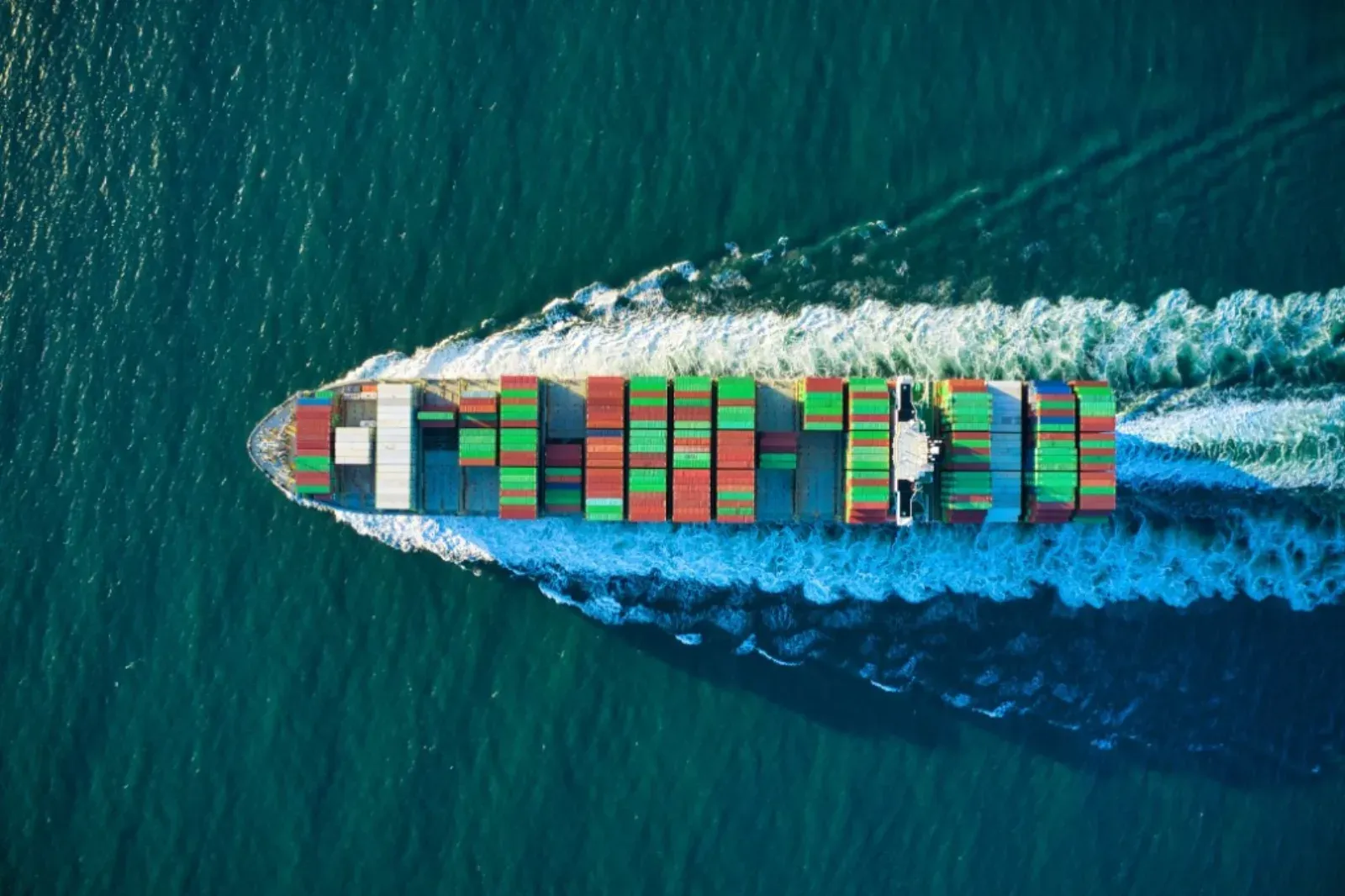
Cut-off at the terminal near Poznań is at 17:30, and the set with the container is still under loading in Konin at 14:50. One hundred and thirty kilometres remain, a quarter of an hour for the gate and weighing, and a decision to make in ten minutes: the unit goes on the train to Duisburg or the whole route runs on wheels. This article is about that decision calculated, not narrated.
Intermodal Transport: What It Is and How It Differs from Ordinary Road Haulage
Intermodal transport is the carriage of one loading unit — a container, semi-trailer, or swap body — by at least two modes of transport, without reloading the goods themselves. The carrier changes — truck, wagon, or vessel — and the load stays untouched in the same unit from shipper to consignee.
A Definition That Works in a Conversation with the Customer
For sales, one sentence is enough: we move the box, not the goods. The dispatcher needs the operational version, in which intermodal is not a transport mode but a route made of three legs and two reloads, where the critical resource stops being the driver and becomes the train departure time.
Loading Unit: Container, Intermodal Semi-Trailer, Swap Body
The ISO container is the most universal unit, because it fits on a vessel, a wagon, and a road chassis. A forty-footer weighs 3.7 to 3.9 tonnes in tare, and its CSC plate limits gross weight to 30,480 kg, which gives about 26.6 tonnes of chargeable load. An intermodal semi-trailer is reinforced and fitted with grab pockets, half a tonne to a tonne heavier, but accepts loads that will not fit in a container. A swap body is the lightest and is not suitable for stacking; in land distribution it stands on supports at the customer while the tractor works elsewhere. The proportions in Poland are clear: containers account for more than 90 percent of handled units, semi-trailers only about 5.2 percent, which the Office of Rail Transport points to as unused market potential.
Accompanied and Unaccompanied Carriage: When the Driver Travels with the Load
In unaccompanied carriage, which is most of the traffic, only the unit goes onto the wagon, the driver finishes work at the terminal, and returns on another job. That is the cheaper variant and it delivers real savings in labour cost. Accompanied carriage, colloquially rolling road, means the whole set with the driver enters, the driver resting in a passenger wagon, and it makes sense on transit through countries with strict truck restrictions and when you have no partner for final delivery.
What Payload and Capacity Come into Play
Payload in intermodal is counted in three places at once, and the lowest limit wins: permissible gross weight of the set on the road (40, 42, or 44 tonnes), the unit’s CSC plate, and permissible gross weight of the wagon, which with standard flat wagons is practically never the bottleneck.
Work it out on the delivery set: three-axle tractor about 8.5 tonnes, container chassis 4.5 tonnes, 40-foot container 3.8 tonnes. Together 16.8 tonnes tare, so at the 40-tonne limit 23.2 tonnes of chargeable load remain, and at 44 tonnes 27.2 tonnes, provided the CSC plate allows it.
Intermodal, Multimodal, Combined, Bimodal: Where the Difference Lies
Four terms describe four different things: the way goods move, the shape of the contract, a legal category, and a technical design. Mixing them costs money, because permissible weight and access to driving-ban exemptions depend on how the carriage is classified.
Intermodal vs Multimodal Transport
The difference between intermodal and multimodal lies in what is being described. Intermodal concerns the loading unit: the same box travels through several transport modes and nobody touches the goods inside. Multimodal concerns the contract: one operator is responsible for the whole route on one document, and the goods may be repacked en route.
A carriage can therefore be multimodal without being intermodal, when the operator delivers groupage to a port, repacks it into a group container, and sends it on. It can also be intermodal without being multimodal, when you buy delivery, rail, and collection separately.
Intermodal vs Combined Transport
Combined transport is a legal term, not a descriptive one, and that is the most important point in this chapter. Under Council Directive 92/106/EEC, we speak of it when a semi-trailer, swap body, or container from 20 feet uses the road on the initial or final leg and rail, inland waterway, or sea transport on the remainder, provided that leg exceeds 100 km in a straight line.
The road leg is limited, and that is where most carriages fail at inspection. With rail, delivery and collection must lead to the nearest suitable transfer station; with an inland or seaport they must fall within 150 km in a straight line. If you haul a container 300 kilometres past three terminals, the carriage is not combined, even if the unit really went by train.
Intermodal vs Bimodal Transport
Bimodal is a technical solution, not a legal category. The semi-trailer has a reinforced frame and kingpins allowing it to be placed on a rail bogie, so it becomes part of the wagon and does not need a flat wagon, as in RoadRailer-type systems. The niche follows from the arithmetic: such a semi-trailer is more expensive and heavier, runs only on relations served by compatible rolling stock, and every terminal needs bogies in the right number and place. No crane at reload does not offset the loss of flexibility, which is why bimodal serves closed relations, not the spot market.
Comparison Table: One Contract, One Unit, Number of Reloads
| Feature | Intermodal | Multimodal | Combined | Bimodal |
|---|---|---|---|---|
| One contract for the whole route | not a requirement | yes, that is the essence | not a requirement | not a requirement |
| Same unit from shipper to consignee | yes, a necessary condition | not necessarily | yes | yes, the unit is the semi-trailer |
| Reloading of the goods themselves | zero | possible en route | zero | zero |
| Legal basis in the EU | no operational definition | no EU legal definition | Directive 92/106/EEC | none, technical description |
| Limit on the road leg | none | none | nearest station or 150 km from port | delivery and collection |
| Access to 44 tonnes and ban exemptions | only when it meets the combined definition | not implied by the contract | yes, when conditions are met | yes, if it meets the combined definition |
Why This Distinction Shows Up in Paperwork and Price
Sales sells the carriage as intermodal because it sounds better, and the inspector on the road asks for the document confirming combined transport, because only that justifies 44 tonnes and driving on Sunday. The abbreviations circulating in those conversations, from TEU through FTL to CIM, are collected in our glossary of terms and abbreviations in transport.
Examples of Intermodal Transport on Polish Lanes
Four setups that really run, each with a different reason: port volume, transit bans, maritime geography, and delivery windows in the city.
Container from Gdańsk to Silesia: Rail Plus Final Delivery
The most mass-market pattern in Poland. The container comes off the ship at Baltic Hub, travels on a block train to a terminal in Gliwice, Sławków, or Dąbrowa Górnicza, and there a tractor takes it for delivery within a few dozen kilometres. The rail leg is about 500 to 550 kilometres, so it sits in the range where rail wins without discussion. The bottleneck is not the train but rotation of the empty container, because the shipping line expects the box back at a designated depot within a set time.
Semi-Trailer on Poland–Italy via a Terminal in the Czech Republic or Austria
The set hauls an intermodal semi-trailer to a terminal in southern Poland or the Czech Republic, the semi-trailer goes onto a flat wagon, and the train crosses the Alps towards Padua or Novara. The reason is prosaic: transit through Austria and Switzerland is burdened with night and weekend restrictions, and Alpine tolls eat the margin on the whole lane. The driver does not travel with the load, a local partner collects the semi-trailer, and the Polish tractor takes the next job within a hundred kilometres of the terminal.
Short Sea: Gdynia and Świnoujście towards Scandinavia
On Scandinavian lanes the main leg is a ferry or short-sea vessel, and the unit may be either a container or a semi-trailer without the tractor. This variant has an important legal feature: with a water leg, permissible delivery is counted within 150 kilometres of the port, which gives more freedom in choosing the loading point than the nearest-station rule on rail.
Swap Body in Night Distribution
Parcel operators move swap bodies between hubs on a night train, because the window between closing the sort centre and starting delivery runs is predictable and repeatable. The swap body stands on supports at the ramp in the morning, and the tractor does not wait for unloading but takes the next one. It is the closest relative of cross-docking in the rail world, because everything rests on hour discipline, not floor space.
How to Draw This Chain on One Slide
If you are preparing a presentation, all of intermodal transport comes down to four blocks linked by arrows: road delivery from shipper to departure terminal, reload onto wagon or vessel, main leg by rail or sea, and finally reload and road collection to the consignee. Under the arrows add three numbers that turn the slide into operational material: delivery distance, cut-off time at the departure terminal, and transit time on the main leg. Unit type and rail operator name belong in a footnote.
Intermodal Transport in Poland: Data, Terminals, and Direction for 2026
Polish intermodal has been growing since 2024, but moderately and unevenly through the year. The figures below come from Office of Rail Transport statistics published on the UTK data portal.
How Much Intermodal Traffic Moves on Polish Rail
In 2025 rail moved 28.38 million tonnes of intermodal freight in Poland, 2.6 percent more than the year before. Transport work reached 9.61 billion tonne-kilometres (up 2.8 percent), the number of transport units 1.83 million (up 4.9 percent), and volume 2.92 million TEU (up 7.4 percent).
More important than volumes is market share: 13 percent by mass and 17.1 percent by transport work of all rail freight, the highest in UTK statistics. The gap between mass and transport work says everything about the segment’s nature, because units travel farther than the average bulk load. Over ten years mass grew by 111 percent, from 13.43 million tonnes in 2016.
Ports remain the growth engine: they handled a record 3.9 million TEU in 2025, 18 percent more than the year before, with Gdańsk reaching 2.77 million TEU and Gdynia crossing one million TEU for the first time. Rail handles a smaller share of that stream than road haulage, and the whole potential to shift lies in that gap.
Terminals and Corridors Handling Most of the Traffic
There is no point copying an atlas; it is enough to know the points through which most traffic passes. Baltic Hub in Gdańsk and terminals in Gdynia handle the oceanic stream and generate most trains inland, while Małaszewicze remain the eastern gateway, handling according to UTK 89.6 percent of rail shipments from China to the European Union. Euroterminal Sławków has access to broad-gauge track on the LHS line, so a unit from the east comes off 1,520 mm gauge without returning to the border. Kąty Wrocławskie serves the German and Benelux direction, and Poznań and Gądki act as a hub for Rhine and Scandinavian relations.
What Limits Growth Today
Limits are infrastructural and staffing, not demand-driven. Line capacity drops during maintenance, and diversions add hours that cannot be recovered. A slot on a good train at peak is sometimes unavailable, so the plan is built around availability, not the ideal hour at the consignee. Two deficits spoken about less often add to that: multisystem locomotives and drivers ready to run in international traffic. In forwarding this shows up as a sudden timetable change or a cancelled train.
Present and Future: What Changes by 2030
Direction is set by TEN-T Regulation (EU) 2024/1679, which for the core network sets the deadline of 31 December 2030 and requires, among other things, the ability to run freight trains at least 740 metres long and electrification of lines. For the carrier the translation is simple: a longer train means lower unit cost, because locomotive and driver are spread over more platforms.
The regulation also sets quality requirements on European transport corridors, including average train dwell time at the border below 25 minutes and at least 75 percent of cross-border trains reaching destination on time or with delay under 30 minutes. The Baltic–Adriatic corridor matters most for our market. A third factor is shipper pressure: in tenders they ask about emissions per tonne-kilometre, not only the rate.
Intermodal Transport and 44 Tonnes: How Much You Can Really Carry
The weight limit is the most often quoted and most often misquoted benefit of intermodal. It is worth knowing precisely, because the difference between 42 and 44 tonnes depends on which tractor stands in the yard.
42 or 44 Tonnes: What the Limit Depends On
In intermodal transport total weight is 42 or 44 tonnes, depending on the axle layout of the set. Under Annex I point 2.2.2 of Directive 96/53/EC, a three-axle motor vehicle with a two- or three-axle semi-trailer may run at 44 tonnes, and a two-axle motor vehicle with a three-axle semi-trailer at 42 tonnes.
In both cases the condition is the same: the set must carry one or more containers or swap bodies with a combined length of up to 45 feet in an intermodal transport operation. The consequence is blunt: a popular 4x2 tractor with a three-axle container semi-trailer never reaches 44 tonnes, however perfectly combined the carriage may be.
Conditions You Must Meet to Run Legally at 44 Tonnes
The first condition is the axle layout described above. The second is a unit fitting within the 45-foot limit, so two 20-foot containers on one chassis pass, longer combinations do not. The third is linking the carriage to a specific intermodal operation — a train, ferry, or vessel — not a general intention to use rail. The fourth concerns geography of the road leg, where deviation from the nearest-station rule is allowed only to reach the nearest terminal actually serving the given connection. The fifth is documentation, covered in the chapter on paperwork.
What That Means in Chargeable Load
At 16.8 tonnes tare, the 40-tonne limit gives 23.2 tonnes of chargeable load, 42 tonnes gives 25.2 tonnes, and 44 tonnes gives 27.2 tonnes, i.e. four tonnes more than in standard road haulage. The upper limit remains the CSC plate, in practice about 26.6 tonnes for a typical forty-footer.
Translate that to cost per tonne on a 900 km lane. At an intermodal rate of EUR 1.08 per kilometre the trip costs EUR 972, so at 23.2 tonnes that is about EUR 42 per tonne, and at 27.2 tonnes just under EUR 36. Close to 15 percent difference comes from the weight limit alone, without rate negotiation or route change.
ITD Inspection: What You Show on the Road
The inspector does not assess intent, only documents and the weight reading. You show the document confirming combined transport with transfer stations or ports, the consignment note for the current leg, the unit number matching the papers, and the registration document in which for vehicles under point 2.2.2 of Directive 96/53/EC the 44-tonne weight is entered in brackets. The most common mistake is running at 44 tonnes with documentation completed after the fact: if the train did not depart or the unit went another route, the carriage stops being combined and the excess weight stays in the report.
Intermodal Transport and Driving Bans and Traffic Restrictions
Intermodal’s biggest calendar advantage is that the track does not know weekends. That is a conditional advantage, not an automatic one.
Weekends and Holidays: Rail Runs When the Road Stands Still
In Poland the driving ban for vehicles above 12 tonnes applies on statutory days off from 8:00 to 22:00, on the preceding day from 18:00 to 22:00, and in the holiday period on Fridays from 18:00 to 22:00, Saturdays from 8:00 to 14:00, and Sundays from 8:00 to 22:00. Similar restrictions apply in Germany, Austria, France, Italy, and the Czech Republic, each with its own catalogue of exceptions.
The train runs during that time. A unit dispatched on Thursday evening covers the main leg when a road set would stand in a parking area, and on Monday morning it already waits at the destination terminal. The ban stops being a problem and becomes part of the plan, because delivery and collection fit in a few hours on either side of the weekend. We collect deadlines by country before each long weekend, for example in the roundup of truck driving bans for May 2026.
Delivery Leg in Combined Transport vs Exemptions from the Ban
Polish regulations on periodic restrictions and bans on certain vehicle types on roads contain two exemptions relevant to intermodal. The first covers vehicles used in combined transport. The second, narrower and often overlooked, covers vehicles carrying containers unloaded from wagons at a rail station within 50 kilometres.
That is not a general exemption for everyone with a container on the semi-trailer. In judgment II GSK 491/21 of 19 June 2024 the Supreme Administrative Court upheld a penalty for a carrier invoking combined transport, because the carriage performed did not meet the statutory definition — the road leg did not fall within the required limits. Conclusion: before you send the vehicle on Saturday before noon, check whether delivery goes to the nearest suitable terminal and whether you have the document in the cab. Abroad each country has its own catalogue of exceptions, so a Polish exemption does not protect the driver in Germany or Austria.
How to Fit the Train into the Schedule When Half of Europe Stands Still for a Week
The practical rule is: set cut-off as the reference point for the whole week, not the delivery date. If the train on the western lane departs Thursday at 20:00 and Sunday at 22:00, all load collection aligns to those two hours. The second rule is placing rest periods where you stand anyway: a driver who hands over the unit at the terminal on Friday afternoon starts weekly rest in a chosen place, not a random one, and on Monday begins with collection within a hundred kilometres.
Advantages and Disadvantages of Intermodal Transport, Without Marketing
Intermodal is not a better version of road transport, only a different risk and cost profile. You trade flexibility for predictability, and variable cost for fixed cost.
Advantages: Cost on Long Distance, Predictability, Fewer Driver Hours, Emissions
The first advantage is cost and appears only at distance, because the rail leg has a low marginal cost per kilometre. The second is predictability of transit time, because the train does not sit in a jam near Frankfurt, and the timetable, though fixed, is known weeks ahead. The third is driver working hours, because in unaccompanied carriage the person works only on delivery and collection, so one driver handles several long-distance relations at once. The fourth is emissions, an increasingly measurable argument in a tender.
Disadvantages: Fixed Timetable, Slot Loss Risk, Reload Cost, Terminal Availability
A fixed timetable means a twenty-minute delay does not cost twenty minutes but the whole cycle until the next train, sometimes a day. Slot loss risk is asymmetric, because delivery depends on the customer, who may hold the vehicle at the ramp, and cut-off is not negotiable. Reload cost is fixed and independent of distance, so on short routes there is nothing to recover it from, and dependence on one terminal and its opening hours adds to that. The fourth disadvantage concerns empty units, because the container must return to a designated depot within a set time, and empty runs fall on short legs where the rate per kilometre is highest.
When Intermodal Makes No Sense
Intermodal stops paying when door-to-door distance drops below about 300 kilometres, because two reloads and delivery eat the whole saving on the rail leg. It also makes no sense for urgent loads where delivery was due yesterday and the nearest train leaves in the afternoon.
The third group is part of ADR loads, because not every class and not every terminal allows handling of dangerous goods. The fourth is selected temperature-controlled loads, where a reefer container needs power at the terminal and on the wagon, and every stop is a claims risk. The fifth is out-of-gauge loads and everything that does not fit in a unit. The sixth, most often skipped, is relations with uncertain volume, because at two or three units a month you will not build a relation with a rail partner or negotiate a sensible rate.
How Much CO2 Emissions Actually Drop
In a study for the European Environment Agency, greenhouse gas emissions from rail freight were about 18 percent of the average emissions per tonne-kilometre for heavy goods vehicles in the European Union, in a well-to-wheel view, for 2018 data.
Do not transfer that figure straight into a commercial offer. Your chain includes delivery and collection by truck, so real door-to-door reduction depends on the ratio between rail and road legs, and with a short train and long delivery it can be much smaller. An honest declaration counts emissions by leg, not one multiplier for the whole route.
Documents and Procedures: CMR, Consignment Note, and Rail Slot
Paperwork in intermodal has one feature you must get used to: each leg lives on its own document, and the loading unit number ties them together.
CMR on the Road Leg, CIM or SMGS on Rail
On delivery and collection the CMR consignment note applies, issued separately for each leg because carriers at both ends are often different. The rail leg in European traffic rests on the CIM note, and on routes involving countries using the SMGS convention on the joint CIM/SMGS form. The delivery driver does not need the full set of rail documents, but needs data linking the unit to the train: unit number, booking or advance-notice number, and terminal indication. Without that the gate will not let him in.
Document Confirming Combined Transport: What It Must Contain
Directive 92/106/EEC requires the transport document to show loading and unloading stations of the rail leg or ports on the inland or sea leg, because those data allow checking whether the road leg falls within the limits. In practice the document should additionally identify the unit by number, show shipper and consignee, and the date and time of the rail operation. Three most common gaps that end inspection with a report: missing transfer station, data inconsistent with the carriage actually performed, and a document issued for a different unit than the one on the semi-trailer.
Rail Slot and Terminal Advance Notice: Who Books and When the Slot Expires
The slot on the train is booked by the intermodal operator or forwarder, usually several days before departure, and on fixed relations under a contract for a set number of places on the consist. Advance notice at the terminal gate is done separately and watched separately, because these are two different bookings: one concerns place on the wagon, the other the entry window onto the yard. The slot expires at cut-off, which at container terminals typically falls two to four hours before planned departure of the train, and the booking fee usually does not return.
Liability and Insurance at Module Handover
Most disputes arise not en route but at reload, because custody changes there. Classic scenario: damage to a container corner or semi-trailer tarp noticed only on collection, when nobody can say whether it happened at the departure terminal or in the port. Defence is cheap and consists of documenting unit condition at every handover: photos of four sides and roof on handover, a report with seal number, a note on the CMR. In the policy check whether liability covers the unit while standing at the terminal and how the moment of custody transfer is defined, because standard road carrier insurance does not always cover the time between handover and loading onto the wagon.
How to Synchronise Truck, Train, and Loading Window
The whole difficulty of intermodal fits in one sentence: you have a fixed point in the middle of the route, and everything on both sides is moving.
Terminal Cut-Off: The Hour from Which You Count the Whole Plan Backwards
Build the plan backwards from cut-off. If the train departs at 20:00 and cut-off is 17:30, loading at the shipper cannot finish later than 14:30 with 130 kilometres of delivery. In the schedule enter cut-off, not departure time, because terminal handling sits between them. That hour should be an order parameter, not one person’s knowledge, because a terminal changing cut-off for maintenance triggers a cascade of delays.
Delivery and Collection: Why a Radius of up to 100 km Decides the Bill
The rate per kilometre on delivery is the highest in the whole chain, because the vehicle works on short legs, with empty return and many operations per working hour. In calculations in the next chapter I use EUR 1.60 per kilometre on delivery and collection, against EUR 0.79 on the rail leg. With delivery up to 100 kilometres the bill closes; at 150 kilometres the break-even point for the whole relation moves up by several dozen kilometres; at 200 kilometres on each side it is hard to defend intermodal below a thousand kilometres. Terminal choice is therefore a cost decision, not logistical convenience.
Buffers: How Many Minutes to Leave for the Gate, Weighing, and Reload
Realistic buffers at a container terminal: 15 to 20 minutes for the gate and documents, 10 minutes for weighing, 20 to 40 minutes for positioning under the crane and lifting the unit. On top of that 60 to 90 minutes reserve before cut-off, because peak at the gate happens exactly when everyone delivers to the same train. Slot and advance-notice discipline works here exactly like in road reload operations, which we break down in the article on cross-docking in logistics, with one difference: there a delay shifts the queue, here you miss the train.
Plan B When the Train Is Six Hours Late
Six hours’ delay means three decisions to take at once. Whether collection will make the window at the consignee, whether it must be moved and who calls the customer. What the collection driver assigned to this unit does, because four hours standing is four hours of unused shift. Whether for a critical delivery it pays to take the load from the intermediate terminal by road.
The condition for making those decisions on time is information, not a phone call to the rail operator. Train status and real collection ETA from telematics should land in the same place as the schedule, so moving the consignee window is a reaction, not an explanation after the fact. We compare ways of building such a schedule in the article on transport planning models.
How Much Intermodal Costs vs Road Transport: Numbers on Four Distances
The values below are an indicative calculation for a 40-foot container with a 24-tonne load on lanes from Poland to Western Europe, counted door-to-door, from shipper ramp to consignee ramp. They are a reference point for your own spreadsheet, not a price list.
Indicative ONYX calculation for a 40-foot container with a 24 t load on Poland–Western Europe lanes, 2026. Intermodal rate includes delivery, reload, rail carriage, and collection.
| Distance | Road EUR/km | Intermodal EUR/km | Difference | What Prevails |
|---|---|---|---|---|
| 300 km | 1.35 | 1.74 | +0.39 | delivery and reload eat the whole rail saving |
| 600 km | 1.24 | 1.28 | +0.04 | tie; slot availability and consignee window decide |
| 900 km | 1.19 | 1.08 | -0.11 | rail starts winning; fewer driver working hours |
| 1200 km | 1.16 | 0.96 | -0.20 | intermodal clearly cheaper if the terminal is on the route |
What Goes into the Cost per Kilometre in Both Variants
In the road variant over 1,200 kilometres the rate of EUR 1.16 per kilometre breaks down roughly as follows: EUR 0.45 fuel, EUR 0.20 tolls and road charges, EUR 0.28 driver pay and per diem, EUR 0.20 depreciation, service, tyres, and insurance, EUR 0.03 overheads. The share of tolls changes most strongly by country and emission class, and we collect current rates in the road tolls roundup.
In the intermodal variant the same 1,200 kilometres split into three items: delivery 80 km and collection 90 km at EUR 1.60 per kilometre give EUR 272, two reloads at EUR 33 each give EUR 66, and the rail leg of 1,030 km at EUR 0.79 per kilometre gives EUR 814. Total EUR 1,152, i.e. EUR 0.96 per kilometre door-to-door.
The same structure at 300 kilometres looks completely different, and that is the whole answer to the threshold question. Delivery and collection are 115 kilometres, i.e. EUR 184, reloads still EUR 66, and the short rail leg of 185 kilometres costs EUR 272 because fixed train costs do not scale down. Total EUR 522, i.e. EUR 1.74 per kilometre. How cost structure changes with relation length we break down in the comparison of domestic and international transport.
Where the Break-Even Point Falls
The intermodal break-even point usually falls around 650 to 700 kilometres door-to-door, with delivery and collection within a hundred kilometres of the terminal. Below that line two reloads and expensive delivery kilometres have nothing to recover from; above it every hundred kilometres works in rail’s favour.
The threshold moves both ways. Up, even to 850 or 900 kilometres, when delivery exceeds 100 kilometres, the terminal lies off the natural route, or the reload rate is higher than the EUR 33 assumed here. Down, towards 550 kilometres, when the terminal is on the route, you have a contract slot, and use the 44-tonne limit, because then not only cost per kilometre counts but cost per tonne.
Example for a Fleet of 20 Sets: What Changes in a Month
Take a carrier with a fleet of 20 sets serving a fixed 1,100 km lane to the Rhineland, with 48 one-way trips per month.
| Parameter | Road variant | Intermodal variant | Difference |
|---|---|---|---|
| One-way trips per month | 48 | 48 | unchanged |
| Cost of one trip (EUR) | 1276 | 1056 | -220 |
| Monthly cost of the lane (EUR) | 61,248 | 50,688 | -10,560 |
| Driver working hours on the lane | 1056 | 384 | -672 |
| Sets tied to this lane | 5 | 2 | -3 for other work |
| Main risk | driving bans, jams, checks | slot loss, train delay | different profile, not smaller |
The EUR 10,560 saving comes from EUR 0.20 per kilometre difference over 52,800 work kilometres, so a two-cent deviation in the intermodal rate changes the result by more than a thousand euros. The drop in driver hours from 1,056 to 384 is not only cost but real relief in the roster, because the driver returns home the same day. Three freed sets have value only if you have work for them.
Line Items People Forget
The first is detention, a charge for holding the container outside the terminal beyond free time, and demurrage, a charge for the unit standing at the terminal beyond allowed days. Rates depend on the shipping line and port, rise stepwise with each day of delay, and they most often destroy the bill on ocean lanes where the customer unloads the container a week late.
The second is the cost of the unit standing at the terminal when collection did not happen because the consignee’s warehouse was closed. The third is return of the empty container to a designated depot, often in a different city than the unloading point, i.e. kilometres not in the offer. The fourth is a deposit for the unit, freezing cash for the rotation period. The fifth, most painful, is the cost of a unit that missed the train, because the slot fee does not return and the load must be delivered by road at spot rate.
Role of the TMS in Linking Road and Rail
Intermodal is above all an information problem. Three legs, two or three carriers, two terminals, and one cut-off hour that everyone must know in the same version.
One Order, Several Legs: What It Looks Like in the System
In a spreadsheet intermodal falls apart into three independent rows that nobody can tie to the profitability of one lane. It should be one order with three legs, a shared loading unit number, and status at the level of the whole chain, not only the current vehicle. In practice that means the order has a field for cut-off and booking number, each leg has its own executor and its own rate, and a change in train departure time recalculates delivery and collection deadlines. In ONYX TMS multi-leg planning sits in one day view together with advance notices and vehicle statuses, so the dispatcher sees units at risk of cut-off before the terminal calls.
Delivery ETA from Telematics vs Terminal Cut-Off
The value of delivery ETA to the terminal is higher than in ordinary transport, because the consequence of delay is not linear. Twenty minutes at the customer’s ramp is twenty minutes late; twenty minutes at the terminal gate after cut-off is a day. So match ETA from the vehicle not to the consignee window but to cut-off, and the system, not the planner, should raise an alarm when the forecast exceeds that hour minus buffer. How much that precision is worth in money we settle in the article ETA Is Money.
Settlement: Cost per Leg, Margin on the Whole Chain
The most common mistake in intermodal settlement is counting margin on the whole relation without splitting by leg, because then you do not know whether you lose on delivery, rail, or collection. Only cost assigned to a leg shows that a relation with 6 percent profitability has a healthy rail leg and delivery sold below cost. On top come items unrelated to kilometres: reloads, slot fees, detention. In ONYX TMS 2.0 we are developing road-and-rail chain planning together with cross-dock handling and dynamic time windows, precisely so cost and status live at leg level, not whole-order level.
Summary
Intermodal transport is a tool for a specific job, not a strategic direction in itself. It works when the relation exceeds about 700 kilometres, the terminal lies within a hundred kilometres of loading and unloading points, and volume is repeatable enough to contract for a slot. Below those conditions wheels will be cheaper and faster, and there is nothing embarrassing in that.
Two things deliver the fastest return. The 44-tonne limit, but only with a three-axle tractor and the document confirming combined transport in the cab, because four more tonnes per trip is about 15 percent less per tonne. And the weekend when the train runs and the road stands still, provided delivery really meets the definition of combined transport, which the 2024 Supreme Administrative Court judgment showed very literally.
Checklist Before the First Intermodal Job
- Calculate door-to-door distance and distance to the nearest suitable terminal on both sides, separately for delivery and collection.
- Check tractor axle layout, because without a three-axle motor vehicle you will not use the 44-tonne limit.
- Confirm cut-off time and gate advance-notice rules with the operator and record both in the order, not in an email.
- Agree who issues the document confirming combined transport and whether it contains transfer stations.
- Check in the policy whether liability covers the unit while standing at the terminal and during reload.
- Agree detention and demurrage terms and empty container return location, including kilometres to the depot.
- Plan a 60 to 90 minute buffer before cut-off and a procedure if the slot is lost, with the name of the decision-maker.
- Run the first carriage on a lane you know from road, so you have your own reference point in cost and time.
If you want to see how delivery, cut-off, train, and collection look as one order with cost counted on each leg, see what ONYX TMS offers or contact us and book a demo on your lanes. We will calculate the break-even point on your terminals and your rates, not on the example from this article.