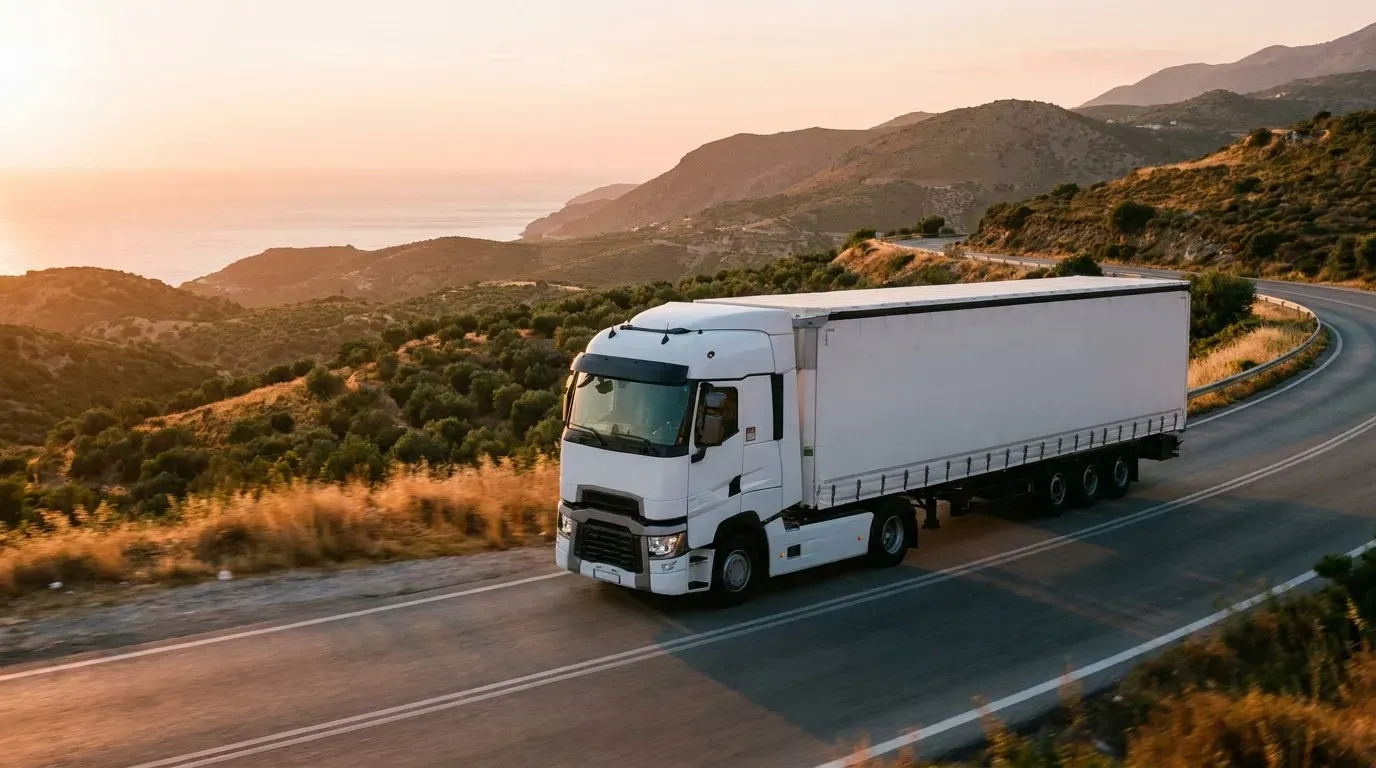
Need a truck from Poland to Germany, France or further, with goods waiting to be loaded? Find a carrier you can trust with them.
This guide shows where to find a carrier, how to check a Polish trucking company in official registers and what to put in the transport order.
The last part shows how to book road freight with a verified carrier without a forwarder.
Where to find a carrier for international road freight
How do you find a carrier to take your goods from Poland to the Ruhr or to northern Italy? You have several channels.
Each gives you something different, and each needs a different kind of care.
| Channel | What you get | What to watch |
|---|---|---|
| Recommendations and your own carrier base | You know the company from earlier loads or a recommendation. | The base is often small. In peak season there may be no free truck on your route. |
| Ads and industry groups | Fast contact with many companies. | You check the company details yourself, from scratch. |
| Freight exchanges | A wide choice of offers on popular routes. | There are many offers, so checking each company takes time. |
| Forwarder | Someone else finds the truck and follows the load. | You sign the order with the forwarder, not directly with the carrier. |
| Order direct to a verified carrier | You add an order and the system picks a verified vehicle. | Loading in Poland. More countries are being added. |
The last channel is Transport orders for shippers in ONYX. It is for you if you ship your own goods, for example as a manufacturer or distributor.
Whatever the channel, checking the carrier works the same way. The next part describes it.
Before you start looking, decide on the vehicle type. Full pallet loads on a long route usually go on an articulated truck with a semi-trailer, smaller loads on a rigid truck, and temperature-controlled goods in a reefer.
Ask about experience on your route too. A carrier that runs to France or Spain regularly knows the unloading points, driving bans and toll roads on that route.
How these channels look from the carrier’s side is covered in our article on sources of orders and their pathologies.
How to check a haulier in Poland before you book
You check five things: the company’s identity, its VAT status, its authorisation to carry goods, its OCP insurance and the documents for the specific load. You can confirm each one in a public register or in a document from the carrier.
- Company identity in CEIDG or KRS.
- VAT status and bank account on the white list, and in VIES for a company from another EU country.
- Permit and community licence in the GITD register.
- OCP policy (the carrier’s liability insurance) with a sum insured and scope that fit your goods.
- Vehicle, driver and documents on the day of loading.
Most Polish registers below are in Polish only. Each step names the register and explains what it holds.
This article is general information, not legal advice. Confirm unusual cases with a lawyer or an insurer.
Registers and legislation described as of 27 October 2026.
1. Company identity: CEIDG or KRS
Sole traders and partners in civil-law partnerships are listed in CEIDG, the Polish register of business activity. Commercial companies are in KRS, the National Court Register.
Compare the name, NIP (the Polish tax identification number), address and legal form with the details in the offer and in the email signature. Check also that the email domain matches the company.
Where to check: The company search on biznes.gov.pl searches CEIDG and KRS at the same time. You can also check companies in the KRS search of the Ministry of Justice (in Polish).
2. VAT status and bank account: white list, VIES
The list of VAT taxpayers, known as the white list (wykaz podatników VAT), shows the company’s status, for example “active VAT taxpayer”.
It also lists the bank account numbers the company has reported to the tax office. This follows from art. 96b of the Polish VAT Act (Polish text).
Before the first transfer, check that the account number on the invoice is on the list. If the carrier is based in another EU country, check its VAT number in VIES.
Where to check: The white list of VAT taxpayers and the description of the list by the National Revenue Administration (both in Polish). You can check a VAT number from another EU country in the European Commission’s VIES system.
3. Authorisation: permit and community licence
As a rule, the Polish Road Transport Act (ustawa o transporcie drogowym, Polish text) requires a carrier to hold a permit to pursue the occupation of road haulage operator (art. 5). International transport also needs a community licence (art. 5a), which a company receives if it already holds the permit.
Other differences between domestic and international transport, such as documents and driver working time, are covered in Domestic vs international transport.
In Poland, the community licence for the carriage of goods is issued by the Chief Inspectorate of Road Transport (GITD) (in Polish). The carrier receives the licence and an extract (wypis) for each vehicle.
Ask for a copy of the licence and the extract (wypis) for the truck that will carry your goods. Then check the details in the register.
KREPTD is the national register of road transport undertakings kept by GITD. Its public data includes the company’s name and address, NIP, permit status, number of vehicles, and the number, status and validity of the community licence.
The second source is the GITD register of valid administrative decisions. It consists of CSV files with valid goods licences and permits: company name, address, licence number and expiry date.
The file has no NIP column, so you search for the company by name or licence number.
The national registers of EU countries are connected in the European ERRU network. It serves data exchange between authorities, and as a shipper you use the national search.
Keep in mind that a valid licence does not confirm that the carrier’s insurance policy is in force. You check that separately.
Where to check: The KREPTD search, the description of the KREPTD register by GITD and the GITD register of valid administrative decisions (all in Polish).
4. Insurance: the carrier’s OCP policy
OCP is the Polish carrier’s liability insurance (ubezpieczenie odpowiedzialności cywilnej przewoźnika). It covers the carrier when it is liable for damage to your goods.
Ask for a copy and check:
- the policy period and proof that the premium is paid,
- the sum insured against the value of your goods, and whether it decreases after a claim is paid,
- the territorial scope, which covers the whole route,
- exclusions for your type of goods, for example electronics or temperature-controlled cargo,
- clauses on subcontractors and on leaving the vehicle unattended.
In international transport, the carrier’s liability is limited by the CMR Convention (Polish publication). Compensation for lost goods does not exceed 8.33 units of account (SDR) per kilogram of gross weight short.
This limit in art. 23(3) was introduced by the 1978 Protocol to the CMR Convention (Polish publication), which has bound Poland since 2011.
For valuable cargo, this limit may not cover the loss. The sender can then declare a higher value of the goods under art. 24 CMR (1956 text of the Convention).
You enter the declared value in the CMR consignment note and agree the surcharge with the carrier. That value then replaces the limit in art. 23(3).
Ask the carrier’s insurer whether the OCP policy covers such a declaration. Our glossary of road transport terms also explains CMR and OCP.
The Polish Road Transport Act does not list an OCP policy among the conditions for the permit or the licence.
A carrier shows financial standing through capital and reserves, and the authority may accept a bank guarantee or insurance instead, including professional liability insurance (art. 7(1) and (2) of Regulation (EC) No 1071/2009).
That is why you write the OCP requirement and its minimum sum into your order terms.
5. Vehicle, driver and documents on the day of loading
Compare the registration number and the driver’s details with the order before the goods go onto the trailer. If a different truck or a different company turns up, stop the loading and clear it up with the carrier.
Check that the CMR consignment note is filled in and signed. Do not rely only on scans sent by email.
Check registers and the policy regularly, also for carriers you have worked with for years.
Warning signs
- The company details in the documents do not match the email domain.
- The carrier pushes for fast loading or prepayment.
- The account on the invoice is not on the white list.
- There is no copy of the licence or extract for the vehicle.
- The carrier will not give the registration number in advance.
- There is no written order confirmation.
Carrier checklist
| What you check | Where | What it confirms |
|---|---|---|
| Name, NIP, address, legal form | biznes.gov.pl, KRS | The company exists and the details match the offer. |
| VAT status and bank account | White list of VAT taxpayers | The company is a VAT taxpayer and the account is reported. |
| VAT number of an EU company | VIES | The VAT number is active. |
| Permit and community licence | KREPTD, GITD register of valid decisions | The company may carry goods, including internationally. |
| OCP policy | Copy of the policy and proof of premium payment | The policy is valid, and its sum and scope fit the goods. |
| Vehicle, driver, CMR | The order and the documents at loading | The company you booked collects the goods. |
How to book road freight: what goes into the transport order
Ready to book road freight? The transport order is your contract with the carrier, so put in everything that matters for settlement and for any claim:
- Loading and unloading: full addresses, time windows, contact people on site.
- Goods: weight, dimensions, number of pallets, how the load is secured, temperature requirements.
- Vehicle: articulated truck with a semi-trailer, rigid truck or reefer, with the equipment you need.
- Rate and currency: the amount for the whole transport.
- Payment term: the number of days and the documents from which the term runs.
- Extra costs: rules for paid waiting time and for cancelling the order.
- Documents: the CMR consignment note and other documents that travel with the goods.
- Operational contact: who on your side answers the phone during the transport.
Write the payment term and the rules on waiting time and cancellation into the order. Disputes usually start with exactly these points.
Ask the carrier for a written order confirmation. Without it, terms agreed by phone are hard to enforce.
Rate: how to set it
Start with a budget for the transport. Compare offers not only on price but also on experience on your route, vehicle type and payment term.
The cheapest offer without checked documents carries a risk the price does not show.
In ONYX you set the maximum rate, and the system may find a carrier for less.
A carrier for regular cooperation or one-off loads
Looking for a carrier for regular cooperation? Start with a few trial loads on one route before you sign a framework agreement.
In the agreement, set out time windows, the scope of liability, the insurance requirements and the payment term. After each load, rate the carrier on four points:
- punctual loading and unloading,
- communication during the transport,
- complete documents,
- correct invoicing.
On each route, keep a small base of checked carriers and at least one in reserve. When your main carrier has no free truck, you do not start from scratch.
When you renew the agreement, check the registers and the policy again. A licence can be suspended and a policy can expire during the cooperation.
Book direct in ONYX: verified carriers and no commission
Looking for a carrier without going through offers and checking companies from scratch every time? If you ship your own goods, as a manufacturer, distributor or trading company, you can book road freight directly in ONYX.
This is how Transport orders for shippers in ONYX work:
- Direct with the carrier. You connect with a verified carrier.
- No commission. The carrier receives the full amount you pay for the transport.
- You set the maximum rate. The system may find a carrier for less, never for more.
- Add orders the way that suits you. In your ONYX shipper account or through the API, for example from your ERP.
- Follow the transport live. GPS position and ETA until unloading.
You add an order and the system picks a verified vehicle. The carrier accepts or declines the order.
If the carrier declines, the order goes back to the system, which picks the next vehicle from the pool of all companies.
Verification in ONYX does not replace your order terms. You write the OCP requirement and its minimum sum into them, as with any carrier.
Orders are already in the system, with loading in Poland. We keep adding more countries and regions.