

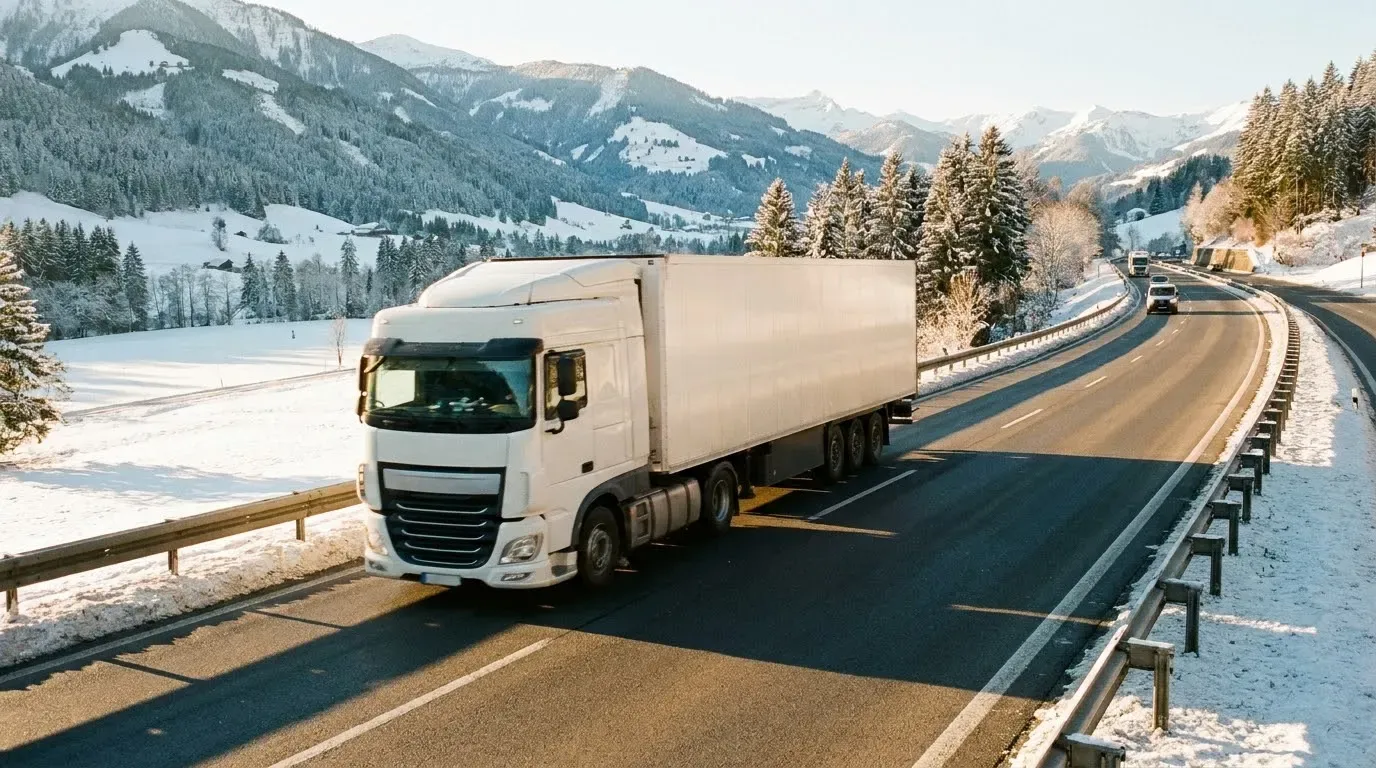
Winter tyres for trucks (HGVs) over 3.5 t mean 13 different sets of rules across Europe. Sweden requires them for five months, whatever the weather. Germany requires them only when there is snow or ice on the road. Poland has no general duty at all.
The main changes took effect over the last two seasons and still apply in winter 2026/27. Germany since October 2024 and France since November 2024 count only tyres with the alpine symbol as winter tyres. Sweden has required winter tyres whatever the weather since 10 November 2025.
This guide is for fleet managers, dispatchers and drivers who run trucks on cross-border lanes. You get a table of 13 countries, a section on each one, and the kit you need on five typical long-haul lanes.
Every rule links to its source, in most cases an official one. We checked the sources on 5 November 2026.
Rules change, and the carrier and the driver are responsible for the vehicle’s equipment. Before each trip, open the link for every country on your route.
Rules in force for winter 2026/27
Some rules changed over the last two seasons, and some have applied for years. All of the ones below apply in winter 2026/27. Check them before your first run to Scandinavia or the Alps:
- Germany, since 1 October 2024: the alpine symbol only. § 36(4) StVZO defines a winter tyre as a tyre with the alpine symbol. The transition period for tyres marked only M+S and made before 1 January 2018 ran until 30 September 2024.
- France, since 1 November 2024: the alpine symbol plus M+S. In mountain zones, a winter tyre is a tyre with both markings. That is what article D314-8 of the French highway code says, as worded by decree 2020-1264.
- Croatia, since March 2025: a new definition of winter equipment. The amendment published in NN 36/2025 lists, for vehicles over 3.5 t, tyres marked M+S, M.S., M&S or 3PMSF on the driven wheels, or type-approved chains.
- Sweden, since 10 November 2025: 10 November to 10 April, whatever the weather. The longer season for trucks, buses and the trailers they tow was set out in a Transportstyrelsen notice of 10 November 2025. Before that, the duty depended on road conditions. Winter 2026/27 is the second season under this rule.
- Norway, standing rules: chains from 1 November, 3PMSF from 15 November. This is not new. A Statens vegvesen notice of 8 October 2026 reminds drivers that a vehicle over 3.5 t carries chains from 1 November. From 15 November, the drive axles and the front steering axle run on 3PMSF tyres.
If your fleet still has M+S tyres without the mountain-and-snowflake symbol, keep them off the drive axles of any truck heading to Germany, Sweden or Norway.
M+S or 3PMSF: how to read the tyre markings
Before you check a country, check the truck tyre sidewall. The rules refer to these markings:
- M+S (also M.S. or M&S, “Mud and Snow”) marks a tread pattern for mud and snow. The tyre maker applies it. It needs no snow traction test.
- 3PMSF (Three-Peak Mountain Snowflake, the alpine symbol) shows a mountain with three peaks and a snowflake. A tyre with this symbol has passed a snow traction test under UNECE Regulation No. 117. § 36(4) StVZO refers to that regulation.
A tyre with both the 3PMSF symbol and the M+S marking meets the marking rule in every country in the table that sets one. An M+S-only tyre no longer does. France requires both markings together.
| Marking | What it means | Where it is enough on the drive axle |
|---|---|---|
| M+S, M.S., M&S | Maker’s declaration, no snow test | Austria, Slovakia, Italy, Slovenia, Croatia |
| 3PMSF (alpine symbol) | Snow traction test (UNECE No. 117) | With M+S, every country in the table; required in DE, SE (or POR, studs), NO, FR (there with M+S) |
| POR (Professional Off Road) | Off-road tyre | Sweden, as an alternative to 3PMSF |
| ET, ML, MPT | Special-purpose tyres | Austria, as winter tyres |
Tread depth is a separate rule. Austria requires 5 mm on radial truck tyres. Czechia requires 6 mm on the drive axles. Sweden and Norway require 5 mm. Finland requires 5 mm on the drive axles in winter. A 3PMSF tyre with shallow tread will not meet these rules.
In practice, the marking tells you whether a tyre counts as a winter tyre at all. The tread depth tells you whether it still meets the rule this season. A roadside check looks at both, so measure the tread before you assume a tyre is fine because of the symbol.
Table: winter tyres and snow chains in 13 countries
The table shows the rules for vehicles over 3.5 t as of November 2026. The order follows typical lanes from Poland. You will find the full description, with fines where the authority or the law states them, below the table in the section for each country.
How to read the columns:
- When: “always” means the duty applies during this period even on a dry road. “In snow, ice” means the duty applies only in those conditions.
- Tyres and axles: the minimum marking and the axles the rule covers. A figure in mm is the minimum tread depth.
- Chains: “carry” means chains on board for the whole period. “At the sign” means you fit them where the sign stands.
- Fines: amounts from the country section below the table. “See source” means we give no amount, because we could not confirm one in the source.
- Source: the law or authority page behind the data in the row.
| Country | When | Tyres and axles | Chains | Fines | Source |
|---|---|---|---|---|---|
| Germany | In snow, ice, frost; no dates | 3PMSF on permanently driven axles and front steering axle | At sign 268 | Driver 60–80 EUR, keeper 75 EUR | StVO § 2 |
| Austria | 1 Nov–15 Apr, always | M+S or 3PMSF on at least one drive axle; 5 mm (radial) | Carry 1 Nov–15 Apr, for 2 driven wheels | See source | oesterreich.gv.at |
| Czechia | 1 Nov–31 Mar in snow, ice, frost or forecast | Winter tyres on drive axle wheels; 6 mm | Max 50 km/h on chains | Up to 2,000 CZK on the spot | Act 361/2000 Coll. |
| Slovakia | 15 Nov–31 Mar and in snow, ice, frost | M+S or 3PMSF on at least one drive axle | No general duty | See source | Act 8/2009 Coll., § 38 |
| Sweden | 10 Nov–10 Apr, always | 3PMSF, POR or studs on drive and front axle; 5 mm | Not on the agency page | See source | Transportstyrelsen |
| Norway | 15 Nov–31 Mar; 5 mm from 1 Nov | 3PMSF on drive axles and front steering axle | Carry from 1 Nov | 1,000–2,000 NOK per tyre, 750–1,500 NOK per chain | Statens vegvesen |
| Finland | December–February | Winter tyres on drive axles (not steered); 5 mm | Not in the decree | See source | Finlex 1380/2016 |
| Italy | Usually 15 Nov–15 Apr, set by the road operator | M+S or chains on board | Alternative to winter tyres | See source | Polizia di Stato |
| France | 1 Nov–31 Mar in mountain zones | Without trailer: 3PMSF + M+S or chains | With trailer: chains or socks always on board | See source | Code de la route, art. D314-8 |
| Switzerland | No mandatory period | No general duty | At sign 2.48, for 2 driven wheels of one axle | See source | SSV art. 29 |
| Slovenia | 15 Nov–15 Mar and in winter conditions | Winter tyres on driven wheels (3 mm) or chains; shovel | Alternative to winter tyres | Driver 40–500 EUR; company 1,000 EUR (missing equipment, stuck vehicle, traffic ban) | promet.si |
| Croatia | 15 Nov–15 Apr on winter sections, always | M+S or 3PMSF on driven wheels, or chains | Alternative to winter tyres | See source | NN 121/2020 |
| Poland | No general duty | No general duty | At sign C-18, for 2 driven wheels | See source | regulation on road signs |
Winter tyres for trucks, country by country
Below is each country from the table. We give fines only where the authority or the law states an amount. For the other countries, we point you to the source.
Germany: a duty tied to road conditions
In Germany, a truck over 3.5 t needs winter tyres only in winter conditions, with no calendar. The duty starts when the road has black ice, packed snow, slush, ice or frost. Under § 2(3a) StVO, vehicles in categories N2, N3, M2 and M3 may then drive if at least the wheels of the permanently driven axles and the front steering axle have winter tyres.
With that minimum set, the driver has extra duties. Before each trip, the driver checks whether the journey is necessary. Speed is limited to 50 km/h. The gap to the vehicle ahead, in metres, must be at least half the speed shown on the speedometer.
No dates does not mean fewer obligations. Once snow falls, the same provision does not allow a truck without 3PMSF tyres on the required axles to drive. That is why trucks that run through Germany are best kept on winter tyres for the whole season.
Only a tyre with the alpine symbol counts as a winter tyre (§ 36(4) StVZO). You fit chains where sign 268 “Schneeketten vorgeschrieben” (snow chains required) stands.
Fines from the BKatV fine catalogue: 60 EUR for the driver, 80 EUR if traffic is obstructed. The keeper who allowed the vehicle to drive pays 75 EUR. For tolls on German roads, see our guide to road tolls in Germany.
Austria: a fixed season and chains on board
In Austria, a truck over 3.5 t runs on winter tyres from 1 November to 15 April. The duty does not depend on snow on the road. At least one drive axle must have winter tyres.
Austria accepts the markings M+S, M.S., M&S and the snowflake symbol. Special-purpose tyres count only with the marking ET, ML or MPT. The minimum tread on a truck winter tyre is 5 mm on a radial tyre and 6 mm on a cross-ply tyre.
In the same period, the truck carries chains for at least two driven wheels (§ 102 KFG). You fit them when snow or ice covers the road. For a combination crossing the Brenner, this means chains in the cab from 1 November, even on a dry road. The official pages do not state fines, so we do not quote amounts. For the cost of crossing Austria, see our guide to road tolls and fuel in Austria.
Czechia: 6 mm on the drive axles
In Czechia, a vehicle over 3.5 t needs winter tyres on all wheels of its permanently driven axles from 1 November to 31 March. Under § 40a of Act 361/2000 Coll., the duty applies when the road has a continuous layer of snow, ice or frost. It also applies when the weather lets you expect such a layer on the route.
The tread on these tyres must be at least 6 mm. On chains, you drive at no more than 50 km/h under the same act.
The Czech police state an on-the-spot fine of up to 2,000 CZK, and 1,500 to 2,500 CZK in administrative proceedings. The notice dates from October 2025, the previous season.
Czechia sits on many lanes from Poland to the south, the Alps and the Adriatic. Its 6 mm drive-axle rule is stricter than the 5 mm in Austria, Sweden or Norway, so it often sets the bar for the whole trip.
Slovakia: at least one drive axle
In Slovakia, a vehicle over 3.5 t needs tyres with the mountain symbol or M+S on at least one drive axle. § 38 of Act 8/2009 Coll. sets this for categories M2, M3, N2 and N3. The provision names the period from 15 November to 31 March and situations with snow, ice or frost on the road.
Readings of this sentence differ. The safe approach is to run winter tyres in that period whatever the weather. The driver must also prepare the vehicle if snow or ice can be expected on the route.
§ 38 does not require you to carry chains. We could not confirm a minimum tread depth or fines in the text of the act. Check them before you travel.
Sweden: five months, whatever the weather
In Sweden, trucks and buses over 3.5 t run on winter tyres from 10 November to 10 April, according to Transportstyrelsen. The duty also covers the trailers they tow and does not depend on road conditions.
The drive axle and the front axle need 3PMSF, POR or studded tyres. M+S is enough on the other axles of the truck and the trailer. Every tyre on the truck needs at least 5 mm of tread. A trailer towed by such a vehicle needs at least 1.6 mm.
The rule has applied since 10 November 2025, so winter 2026/27 is its second season. From 10 November it does not matter whether Skåne is dry: winter tyres are mandatory from the moment you drive off the ferry.
Studs are allowed from 1 October to 15 April. Do not mix studded and non-studded tyres on one axle. The agency page says nothing about chains or fines. For ferries and charges in Sweden, see our guide to road tolls in Sweden.
Norway: 3PMSF, 5 mm and chains
In Norway, vehicles and trailers over 3.5 t run on winter tyres from 15 November to 31 March, according to Statens vegvesen. The drive axles and the front steering axle need 3PMSF tyres. Other axles and the trailer: M+S or 3PMSF.
Tread must be at least 5 mm from 1 November to the first Sunday after Easter Monday. In Nordland, Troms and Finnmark, the period runs from 16 October to 30 April. You carry chains from 1 November, and in the north from 16 October. When snow or ice can be expected, you carry them at any time of year.
Fines are charged per item:
- each tyre without the required tread or marking: 1,000 NOK on a vehicle up to 7.5 t, 2,000 NOK over 7.5 t,
- each missing chain: 750 NOK up to 7.5 t, 1,200 NOK over 7.5 t,
- each missing chain on a vehicle over 7.5 t towing a trailer over 3.5 t: 1,500 NOK.
An example: after 15 November, a tractor unit with a semi-trailer over 7.5 t runs without two chains and with two non-3PMSF tyres on the drive axle. The fine is then 2 × 1,500 NOK for the chains and 2 × 2,000 NOK for the tyres, 7,000 NOK in total.
If grip is insufficient, the police can also stop the vehicle from continuing. The authority does not state how many chains a combination needs. For tolls and ferries in Norway, see our guide to road tolls in Norway.
Finland: winter months and tread depth
In Finland, trucks and buses run on winter tyres in December, January and February. Under decree 1257/1992 as amended by 1380/2016, the drive axles, except driven steering axles, then need at least 5.0 mm of tread, and the other axles and the trailer at least 3.0 mm.
The decree names no tyre marking and no fines, so check them with Traficom, the Finnish transport agency, before you travel. For ferries and getting there, see our guide to road tolls in Finland.
Italy: orders from road operators
In Italy, a truck faces no single national duty. According to the Polizia di Stato, the highway code lets road owners and operators order winter tyres, or chains on board. The duty usually runs from 15 November to 15 April. In the mountains and the north, the dates can start earlier.
Roadside signs show where the duty applies. Winter tyres carry the marking M+S, MS, M-S or M&S. With other tyres, you carry chains. Studs are allowed only up to 3.5 t.
Missing equipment brings a fine, and the driver is told not to continue without it. Amounts depend on the provision, so check the order for the stretch you drive.
On the Brenner lane, the Italian stretch is the A22 motorway. Its operator states that from 15 November to 15 April you need winter tyres fitted or chains on board, even without snow.
For tolls, see our guide to road tolls in Italy.
France: mountain zones
In France, a truck needs winter equipment from 1 November to 31 March in mountain communes designated by the prefect. Signs stand at the entry and exit of each zone, as the explanatory note of the Territoire de Belfort prefecture explains.
A truck with a trailer or semi-trailer always carries chains or snow socks, even on winter tyres. A truck without a trailer has winter tyres or carries chains. Since 1 November 2024, a winter tyre is a tyre with both the alpine symbol and the M+S marking.
Sign B26 “Chaînes à neige obligatoires” (snow chains required) means you fit chains on a snow-covered road, all year round. We do not give fines, because the prefecture note does not list them. You will find the list of communes in the prefect’s order for each département.
Switzerland: chains only at the sign
In Switzerland, a truck faces no mandatory winter tyre period. The driver must still keep the vehicle under control at all times (TCS, art. 31 SVG).
Chains are mandatory at sign 2.48 “Schneeketten obligatorisch”. Under art. 29 SSV, metal chains then go on at least two driven wheels of the same axle. For transit through Switzerland, see our guide to road tolls in Switzerland.
Slovenia: tyres or chains, plus a shovel
In Slovenia, a vehicle over 3.5 t needs winter tyres on at least the driven wheels from 15 November to 15 March. Outside that period, the duty applies in winter conditions, according to promet.si, the national traffic information portal.
The alternative is summer tyres with chains on the driven wheels. The vehicle also carries a shovel.
A winter tyre has at least 3 mm of tread and the marking M+S, M.S or M&S. In winter conditions, a truck with a trailer may use only motorways and expressways.
Trucks leave the road at areas marked by signs, for example when more than 20 cm of snow is forecast within three hours or when the police order it. Bora winds above 80 km/h or very poor visibility can trigger the same.
Fines according to promet.si:
- 40 EUR: driving without the required equipment, or without chains at a mandatory chains sign,
- 500 EUR and 5 penalty points: a vehicle without the required equipment gets stuck or hinders traffic,
- 300 EUR: ignoring a sign that bans or restricts traffic on a section (elsewhere the portal gives 500 EUR and 5 points for this),
- 1,000 EUR for the company and 120 EUR for its responsible person: the vehicle lacks the required winter equipment, gets stuck and blocks traffic because of inadequate equipment, or the driver ignores a sign that bans or restricts traffic.
Croatia: winter sections
In Croatia, a vehicle over 3.5 t needs winter equipment on designated sections from 15 November to 15 April, whatever the weather. That is set by Decision NN 121/2020. A map in the annex shows the sections.
After the NN 36/2025 amendment, a vehicle over 3.5 t needs tyres marked M+S, M.S., M&S or 3PMSF on the driven wheels. The alternative is type-approved chains on those wheels. Studded tyres are banned. We could not confirm fines in these regulations.
Poland: no general duty
In Poland, a truck does not have to run on winter tyres. Chains are mandatory at sign C-18. Under § 42 of the regulation on road signs and signals, the driver then fits them on at least two driven wheels. A plate under the sign can limit the order to certain vehicles.
Having no duty in Poland does not exempt you anywhere else. A truck leaving Poland for Sweden or Austria meets the rules of the country it is driving in.
Where you must carry chains and where you must fit them
Chain rules fall into three groups. Keep them apart, because a roadside check looks for something different in each.
1. Chains on board for the whole season. You must have them in the vehicle, even on a dry road:
- Austria: 1 November to 15 April, for at least two driven wheels,
- Norway: from 1 November (in the north from 16 October), and whenever you expect snow or ice,
- France: a truck with a semi-trailer in a mountain zone, 1 November to 31 March.
2. Chains as an alternative to winter tyres. You carry them if you have no winter tyres:
- Italy on stretches with an order,
- Slovenia with summer tyres, plus a shovel,
- Croatia on winter sections,
- France for a truck without a trailer.
3. Chains on the wheels at the sign. You fit them where the sign stands:
- Germany: sign 268,
- Switzerland: sign 2.48, two driven wheels of one axle,
- Poland: sign C-18, two driven wheels,
- France: sign B26 on a snow-covered road, all year round.
On chains, slow down. Czechia limits speed to 50 km/h. Match the number of chains to the number of driven wheels, not to the legal minimum. One set for two wheels is enough in Austria. With twin wheels on the drive axle, check that the chains fit your tyre size.
Austria allows chains only when they are mounted so they do not damage the road surface. Buy a set that matches the tyre size and practise fitting it before the season. A driver fitting chains for the first time on a mountain pass at night loses a lot of time.
Equipment on typical cross-border lanes
A long-haul HGV usually crosses three or four countries on one trip. All their rules apply along the way. Equip the vehicle for the strictest of them.
Poland–Germany–Austria–Italy via the Brenner
On this lane, three sets of rules stack up. Germany wants 3PMSF on the drive axles and the front steering axle when roads are slippery. Austria requires winter tyres on the drive axle with 5 mm of tread, and chains for two driven wheels from 1 November. On the Italian A22, winter tyres or chains on board apply from 15 November.
Equipment: 3PMSF tyres on the drive axles and the front axle, with at least 5 mm of tread. Chains for the driven wheels in the cab. Alpine passes also have transit bans and restrictions. We cover them in our guide to truck driving bans in Europe. When snow closes a pass, the driver needs somewhere to stop. Our guide to secure truck parking in Europe helps with that.
Poland–Germany–France–Italy across the French Alps
This lane runs through mountain zones in France, for example on the way to the Fréjus or Mont Blanc tunnels. From 1 November to 31 March, a combination with a semi-trailer carries chains or snow socks there, even on 3PMSF tyres. On a snow-covered road with sign B26, you fit the chains. In Germany, 3PMSF applies on slippery roads, and in Italy the stretch operator’s order applies.
Equipment: 3PMSF tyres on the drive axles and the front axle, chains for the driven wheels in the cab.
Poland–Czechia–Austria–Slovenia–Croatia
This is the lane to the Adriatic. Czechia requires 6 mm on the drive axle wheels in snow and ice, or when the weather lets you expect them. Austria requires chains on board. Slovenia requires a shovel and, in winter conditions, lets combinations with a trailer use only motorways and expressways. Croatia requires winter tyres or chains on winter sections, whatever the weather.
Equipment: winter tyres on the drive axles with at least 6 mm of tread, to meet the Czech rule. Chains for the driven wheels and a shovel. In Slovenia, plan the route on motorways and expressways, because in winter conditions they are the only roads open to a combination with a semi-trailer.
Poland–Sweden–Norway
This lane has the strictest rules in the table. From 10 November, Sweden wants 3PMSF, POR or studs on the drive axle and the front axle, and 5 mm on every tyre of the truck. Norway requires chains on board and 5 mm of tread from 1 November, and 3PMSF from 15 November.
Equipment: 3PMSF tyres on the drive axles and the front axle, at least 5 mm on every tyre of the tractor unit. Semi-trailer: M+S or 3PMSF, and 5 mm in Norway. Chains for the driven wheels. In Norway, the fine grows with every missing tyre and chain, so check the whole combination before you board the ferry to Sweden.
Poland–Baltic states–Finland
Finnish rules from December to February are about tread: 5 mm on the drive axles and 3 mm on the other axles and the trailer. Check the rules of Lithuania, Latvia and Estonia separately, because this guide does not cover them, and see our guide to Finland for the ferries.
Roadside checks, fines and carrier liability
A winter roadside check usually looks at three things: the tyre marking on the right axles, the tread depth, and chains on board where they are mandatory.
The fine is only part of the cost. Downtime often hurts more:
- Italy: the driver is told not to continue without the equipment,
- Norway: if grip is insufficient, the police can stop the vehicle from continuing, on top of any fine,
- Slovenia: the police can remove a truck whose driver does not pull into a designated area, and the owner pays for removing a stuck vehicle (promet.si).
Liability is shared between the driver and the keeper. In Germany, the driver pays a fine, and the keeper who allowed the trip pays a separate one. In Slovenia, the company pays too. That is why you check the equipment before the truck leaves the depot, not at the border.
Before every winter trip, the driver should:
- look at the sidewalls of the tyres on the drive axles and the front axle and find the 3PMSF symbol,
- measure the tread with a gauge at several points on each tyre, and compare the result with the strictest country on the route,
- count the chains in the cab and check that they fit the tyres,
- check the trailer if the trip goes to Sweden or Norway.
Fines for unpaid tolls are a separate topic. We cover them in our guide to road tolls in Europe.
How to prepare your fleet before the first winter run
The simplest approach is to prepare the fleet once, before the first run in November. After that, you only check tyre condition. Work in this order:
- Tyres on the drive axles and the front axle: 3PMSF, with at least 6 mm of tread if the vehicle runs through Czechia, otherwise 5 mm.
- Trailer tyres: M+S or 3PMSF when the vehicle runs to Sweden or Norway.
- Chains: a set for the driven wheels, matched to the tyre size, in the cab from 1 November.
- Shovel: mandatory in Slovenia, useful on any mountain pass.
- A record for each vehicle: tyre change date, tread depth, and whether the chains are on board.
Plan tyre changes by lane. A vehicle on the Sweden lane needs winter tyres from 10 November. A vehicle that runs only between Poland and Germany can change later, but it must have them by the first snow.
Before assigning a vehicle to a winter trip, the dispatcher checks three things: the countries on the route, the strictest tread rule among them, and the chain record for the vehicle. From 1 November, a vehicle without a full set of chains should not get a trip through Austria, Norway or, as a combination with a semi-trailer, the French mountain zones.
In ONYX TMS, you see vehicles with telematics on the map and in the planner. That makes it easier to see where they are heading before you assign a trip to the Alps or Scandinavia.
Summary
Winter tyres for trucks are mandatory across Europe in different ways. Sweden, Austria, Norway, Finland and Slovenia use a calendar that applies whatever the weather, and Croatia does the same on designated sections. Germany and Czechia tie the duty to snow and ice, and Czechia also to the weather forecast. Poland and Switzerland only require chains at the sign.
The safest approach is to equip the truck for the strictest country on the lane: 3PMSF on the drive axles and the front axle, 5 to 6 mm of tread, and chains for the driven wheels on board from 1 November.
We checked the sources on 5 November 2026. Before each trip, open the link for each country in the table, because rules and orders change every season.
Want to see where your vehicles are heading before a winter trip? See ONYX TMS.