

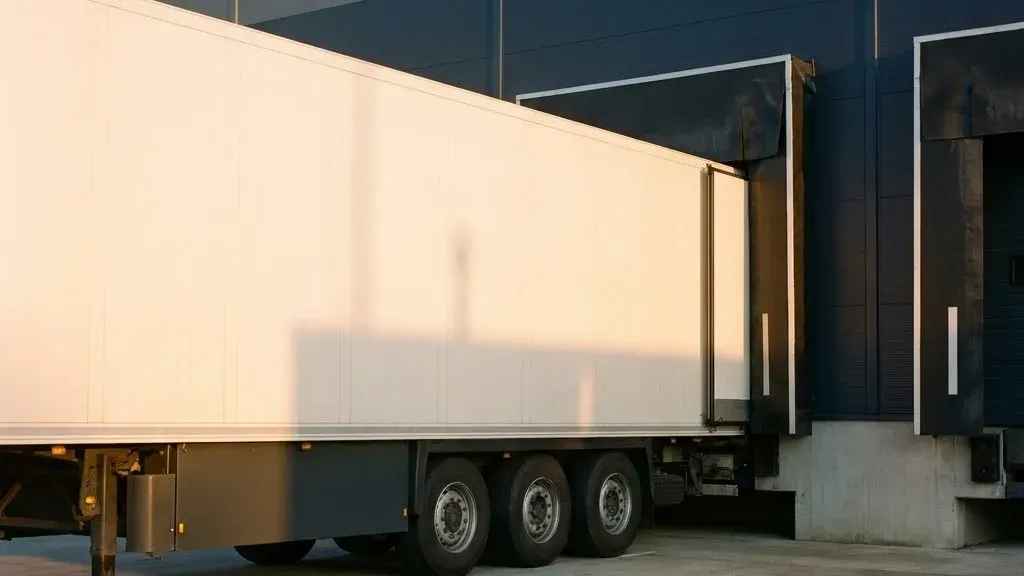
Reefer truck loads from Poland are judged on three things: the temperature of the goods, the ATP class of the trailer and the temperature record during carriage. Only when all three match do you talk about the rate.
This guide is for carriers who run a tractor unit with a refrigerated semi-trailer on cross-border lanes, for example from Poland to the Netherlands or to Spain.
It shows how to read a load offer with a temperature requirement and what to keep as proof after unloading.
Polish offers call a reefer trailer “chłodnia”. The last part of the guide is for shippers looking for a reefer carrier.
What a reefer load offer must state
An offer that says only “reefer” tells you the body type the shipper wants. Reefer loads differ in temperature, goods and documents, so agree seven things before the rate.
| Item | What to agree | Why |
|---|---|---|
| Temperature | One set-point or a range, for example +2 °C to +6 °C. | The temperature decides which trailer class fits. |
| Goods | The name of the goods and whether they are frozen, chilled or fresh. | Frozen food has its own maximum temperatures in the ATP Agreement. |
| Trailer class | The ATP class the shipper requires. | You compare it with the mark on your trailer. |
| Pre-cooling | Whether the shipper wants a pre-cooled trailer, and to what temperature. | The reefer unit needs time, so pre-cooling moves your departure from the yard. |
| Temperature recorder | Whether the shipper wants a printout or a file of the temperature record. | A record from loading and unloading is your proof in a claim. |
| Loading and unloading windows | Ramp hours at both ends of the lane. | The reefer unit keeps running while the truck waits at the ramp. |
| Reefer fuel | Who pays for the reefer unit’s fuel and whether the rate covers it. | The unit runs for every hour of driving and waiting, so its fuel adds to the lane. |
Parameters common to every trailer, such as weight, pallet spaces, EU dimension limits and the basic offer filters, are covered in our guide to curtainsider truck loads from Poland.
Confirm each of the seven items in writing. The consignee can still report damage several days after unloading, and then what the shipper put in the order counts (more in the section on the CMR Convention).
ATP class: what the mark on the trailer means
ATP is the Agreement on the International Carriage of Perishable Foodstuffs and on the Special Equipment to be Used for such Carriage. Poland is a Contracting Party.
The Polish text appears in Poland’s Journal of Laws (Dz.U. 2022 item 1824, in Polish). The same text is also available as a PDF from the Polish Parliament’s service.
UNECE publishes the current English text of the Agreement and the list of its Contracting Parties (UNECE, ATP text and status).
The Agreement covers carriage of frozen foodstuffs and of the foodstuffs listed in its Annex 3. The condition: loading and unloading are in two different States, and the State of unloading is a Contracting Party (Article 3(1)).
The trailer must be selected and used so that the required temperature holds for the whole carriage (Article 4(1)). The same provision asks you to make sure the goods are at the right temperature already at loading.
A reefer’s class says which temperature the unit can hold inside the empty body at a mean outside temperature of +30 °C. According to Annex 1, point 3 of the Agreement:
| Class | Inside temperature of the body |
|---|---|
| A | from +12 °C to 0 °C |
| B | from +12 °C to −10 °C |
| C | from +12 °C to −20 °C |
| D | 0 °C or lower |
| E | −10 °C or lower |
| F | −20 °C or lower |
You read the class from the distinguishing mark on the trailer. FRC is a mechanically refrigerated body with heavy insulation in class C (Annex 1, Appendix 4).
The letter F stands for refrigerated, R for heavy insulation, and the last letter for the class. When you read an offer, compare the temperature of the goods with that class range.
Goods chilled to +2 °C to +6 °C fit class A. Frozen goods need a class that holds a lower temperature.
The ATP certificate and how long it is valid
The trailer is checked for conformity with the standards in three situations (Annex 1, Appendix 1):
- before it enters service,
- periodically, at least once every six years,
- whenever the competent authority requires it.
You carry the certificate of compliance in the vehicle and show it at a roadside check. A plate fixed to the trailer replaces it, but only when a valid certificate is available.
The class marks and the expiry date are shown on the outside of the body, on both sides, in the upper front corners. Check them before every trip with goods covered by the Agreement.
A missing valid certificate shows up at a roadside check. In August 2022, inspectors of Poland’s Road Transport Inspection (ITD) stopped two reefers without valid ATP certificates (GITD, 5 September 2022, in Polish).
One carried yoghurt from Germany to Poland, the other meat from Poland to France. The inspectorate announced administrative proceedings against both carriers.
Frozen goods: maximum temperatures under ATP
Annex 2 of the Agreement sets temperatures the goods must not exceed at any point in the load. The same applies during loading, carriage and unloading.
The figures below follow the official Polish text in the Journal of Laws. The 2024 English edition prints −8 °C on the quick-frozen line, a misprint of the −18 °C that the Polish text gives.
- Ice cream: −20 °C.
- Frozen or quick-frozen fish and all other quick-frozen foodstuffs: −18 °C.
- All frozen foodstuffs except butter: −12 °C.
- Butter: −10 °C.
During defrosting of the evaporator, the Agreement allows a brief rise in the surface temperature of part of the load, by no more than 3 °C.
Reefer load board: how to filter offers
On a reefer load board, filter by the temperature range your ATP class holds. Body type alone also shows you loads your trailer cannot carry.
- Temperature range and class. The class A range ends at 0 °C, so with such a trailer frozen goods drop out at the filter stage.
- Frozen or chilled. Frozen goods come with the maximum temperatures of Annex 2, so filter the two kinds of goods separately.
- Part loads. One compartment holds one temperature. You can combine part loads at different temperatures only in a multi-compartment trailer.
Our guide on how to find loads for a transport company covers every channel where you look for freight, and how to set region and date.
Example: a reefer offer from Poland to the Netherlands
Take this offer: “Reefer, dairy, full truckload, +2/+6 °C, loading near Poznań on Tuesday morning, unloading in Venlo on Wednesday, recorder printout”. You run an FRC trailer with a valid certificate.
Temperature and class. The range of +2 °C to +6 °C fits classes A, B and C, so your trailer fits. Check the expiry date on the mark as well.
Does ATP apply. Loading is in Poland and unloading in the Netherlands, which, like Poland, is a Contracting Party (list of parties, UN Treaty Collection). Check the Agreement text to see whether this dairy product is on the Annex 3 list.
What is missing. The offer says nothing about pre-cooling, reefer fuel or the form of the record. Before you quote a rate, reply to the shipper with three questions:
- To what temperature should I pre-cool the trailer, and by what time?
- Does the rate cover the reefer unit’s fuel?
- Do you need printouts from loading and unloading, or a file for the whole trip?
Confirmation. Put the answers into the order or keep the shipper’s message. Only then quote the rate and plan the return from the Netherlands.
Temperature records and documents on the road
When you carry quick-frozen foodstuffs intended for human consumption, the trailer must have an instrument that measures and records the air temperature (ATP Agreement, Annex 2, Appendix 1).
The instrument meets standard EN 12830, and an accredited body checks it periodically under standard EN 13486. Temperature records are dated and kept for at least one year, and longer for some kinds of food.
With chilled goods, the shipper may ask for a recorder printout in the order. Keep the record even when nobody asks for it.
What the CMR Convention says
The CMR Convention relieves the carrier of liability for damage that comes from the nature of the goods, for example decay (Article 17(4)(d)).
In a vehicle specially equipped to protect goods from heat and cold, this defence has a condition. It works only when the carrier proves two things (Article 18(4)):
- it took all steps incumbent on it in choosing, maintaining and using the equipment,
- it complied with the special instructions it received.
Source: text of the CMR Convention.
The consignee may report damage that was not apparent at delivery in writing within seven days of delivery, Sundays and public holidays excepted (Article 30(1)). So your temperature record must outlast the unloading itself.
A case reported by trans.info (9 October 2019) (in Polish) shows how this plays out in court. Medicines were to travel from Bulgaria to Germany at no more than 5 °C.
Transmission of readings stopped for over 16 hours, and the temperature rose to 13.5 °C.
The Higher Regional Court in Zweibrücken held that the carrier should have instructed the driver to check the temperature at loading, and that the driver had to monitor it regularly on the road. So the duty of care did not end when the reefer unit was switched on.
Before departure and after unloading, collect:
- A printout or file from the recorder from loading and from unloading.
- The temperature of the goods measured at loading, and any reservations in the CMR consignment note.
- A copy of the ATP certificate in the cab, if the trailer has no plate.
- The temperature confirmed in writing, in the order or in a message from the shipper.
The lane from Poland and the reefer’s return
How to plan a loop and look for a return load is covered in our guide on how backhaul loads cut empty kilometres. A reefer adds three questions to that plan.
Previous load. After goods other than food, or after a different foodstuff, the trailer must be cleaned effectively before the next load (Regulation (EC) No 852/2004, Annex II, Chapter IV, point 5). So a food shipper may ask what you carried before and whether the trailer was washed.
Have the answer and proof of washing ready before you accept a return order.
New temperature. When frozen goods wait after the dairy run to the Netherlands, plan time to cool the trailer to the new temperature. Frozen goods after chilled goods mean longer pre-cooling before the ramp.
Trailer class. The return load may need a lower temperature than the one you just unloaded. Compare it with the class on the mark, just as you did leaving Poland.
A reefer can also return with goods that need no temperature control. Agree with the shipper whether the unit should run, and put it in the order.
Each country sets its own truck driving bans and the exemptions from them. In Poland, the ban does not cover perishable foodstuffs listed in the regulation’s annex when they form a substantial part of the load (Dz.U. 2023 item 2423, § 3(1) point 3(l), in Polish).
Other countries set their own conditions for such an exemption, or have none. The legal basis country by country is in our guide to truck driving bans in Europe.
Transport orders assigned to your reefer
An order with a temperature requirement can come straight to your reefer, with no load search. Transport orders in ONYX TMS cover every body type and load in Poland, and ONYX charges no commission on them.
You read such an order the same way as the offer in the example: temperature, ATP class, pre-cooling and record. You accept or decline it, and you see the payment term before you decide.
Explore Transport Orders for carriers
Looking for a reefer carrier? What to put in the order
Give the temperature, the goods and the required ATP class in the order, and the carrier sees at once whether the trailer fits. Also add:
- Whether the goods are frozen, chilled or fresh.
- Pre-cooling before loading and its temperature.
- A recorder printout, if you need one.
- Loading and unloading windows.
Before you choose a company, ask for a copy of the carrier’s liability policy and read its exclusions, including any for temperature-controlled goods. Our guide on how to vet a carrier shows what else to look for in the policy.
You can post a transport order online step by step, and Transport Orders for shippers connect you directly with a carrier.
Reefer loads from Poland: 4 steps to start
- Check your ATP certificate. Look at the class and the expiry date on the trailer.
- Agree the temperature in writing. Put the set-point or range in the order or keep it in a message.
- Keep the record from both ramps. Hold the printouts from loading and unloading for at least one year, as ATP requires for quick-frozen food.
- Check the return load. Compare its temperature with your trailer class before you accept it.
The terms ATP, HACCP and CMR are explained in our glossary of road transport terms.